
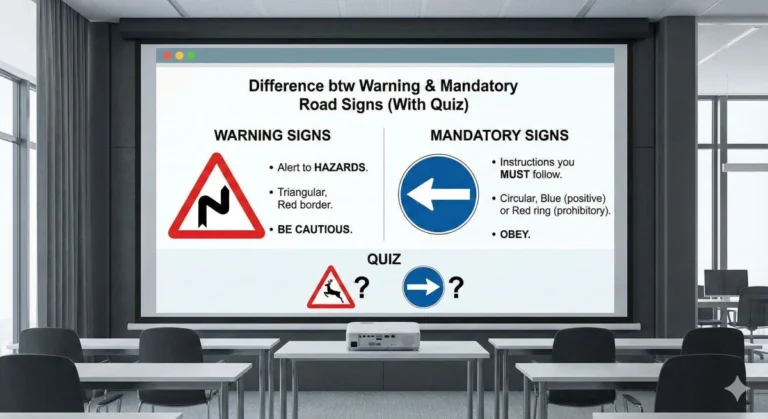
Many learners fail the UK driving theory test because they confuse warning and mandatory signs. Do you know the difference between a blue circle and a red triangle?
Try this quick quiz before reading 👇
Results


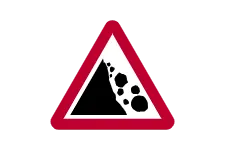
#1. What is the primary shape of a road sign that warns you of a hazard ahead?
Most warning signs in the UK are red triangles with a white background.
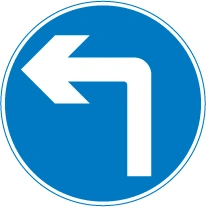
#2. If you see a blue circular sign with a white arrow pointing left what does it mean?
Blue circles are mandatory signs. They give instructions that you must follow.
#3. Which color is most associated with mandatory ‘positive’ instructions in the UK?
Blue circles give positive instructions like ‘Turn Left’ or ‘Cycles Only’.
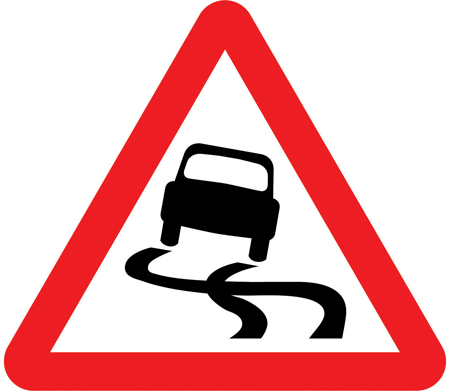
#4. A sign showing a red triangle with a picture of a car skidding indicates what?
The red triangle warns you of the hazard (a slippery surface).

#5. What does a circular sign with a red border (not blue) usually indicate?
While blue circles are mandatory ‘do this’ signs; red circles are ‘do not’ signs.
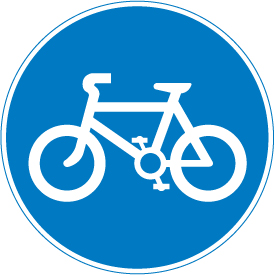
#6. You see a blue circle with a white bicycle symbol. What does this mean?
This is a mandatory sign indicating a specific route for cyclists.
#7. What is the main difference in how you should react to a triangle sign vs a blue circle sign?
Think ‘Triangle = Take Care’ and ‘Circle = Command’.
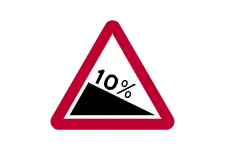
#8. A red triangle with ‘10%’ and a slope symbol means what?
This warns you of a steep gradient so you can adjust your gear or braking.
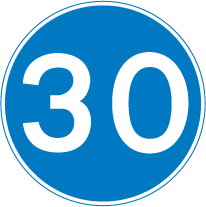
#9. If a sign is a blue circle with the number ’30’ in it what does it represent?
A blue circle with a number is a mandatory minimum speed limit.
#10. Why is it important to distinguish between red triangles and blue circles?
Understanding shapes helps you react faster to hazards and legal requirements.
If you hesitated on the quiz above, you aren’t alone. One of the common road sign mistakes learners make is mixing up the shapes and colors of signs that give orders versus signs that simply warn you.
Why does this matter?
Real UK driving theory road signs questions require split-second decisions. Knowing the visual differences between road signs—specifically shapes and colors—helps you identify hazards quickly, not just in the exam, but on the road.
In this guide, we will break down:
- UK road sign shapes and colors
- The legal requirements shown by road signs
- How to pass exam questions based on road signs
Now, let’s clearly understand the difference so you never get this wrong again.
What Are Warning Signs in the UK?
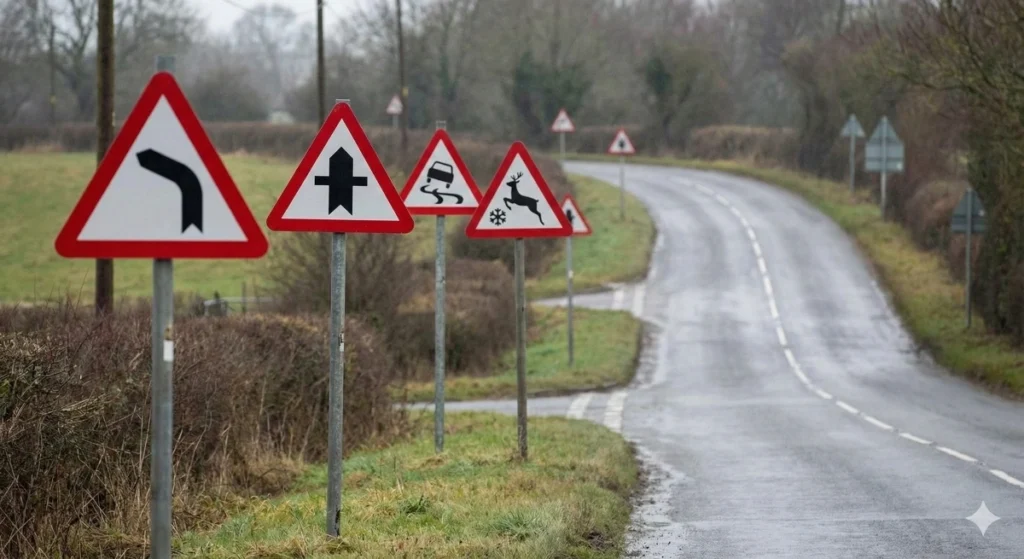
Warning Road Signs Explained
Warning road signs UK are designed to alert you to upcoming hazards on the road that you might not see immediately. These signs do not necessarily give an order (like “stop”), but they tell you to be cautious and adjust your speed.
Visual Identity:
- Shape: Most warning signs are triangular.
- Colour: Red border with a white background and black symbols.
What warning signs tell drivers:
They are signaling danger ahead. This could be a physical change in the road layout or an environmental hazard.
Common Examples:
- Sharp bend: Prepare to slow down.
- Pedestrians ahead: Watch for people crossing.
- Road narrows: Be prepared to give way if necessary.
Try out more Red Road signs quizzes that help with your learnings
What Are Mandatory Signs in the UK?
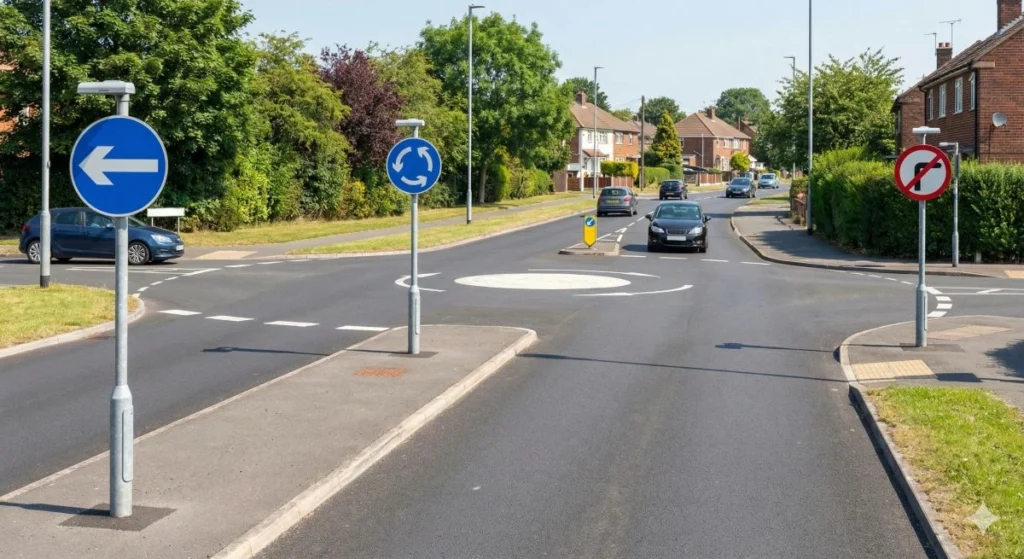
Mandatory Road Signs Explained
Unlike warning signs, mandatory road signs in the UK give instructions that you must follow. Disobeying these signs is a criminal offence. These are the rules you must follow on mandatory signs.
Visual Identity:
- Shape: Mandatory signs are almost always circular.
- Colour:
- Blue circles: These are positive instructions (e.g., “Turn left ahead”). They tell you what you must do.
- Red rings: These are technically prohibitory signs (e.g., “No entry”), often grouped under mandatory orders because they tell you what you must not do.
Obeying mandatory traffic signs:
When you see a blue mandatory sign UK, you have no choice—you must follow the arrow or symbol. Ignoring these can lead to fines and failing your driving test.
Common Examples:
- Turn left only: You cannot go straight or right.
- No entry: You are legally prohibited from entering.
- Mini-roundabout: You must give way to traffic from the right.
Difference Between Warning and Mandatory Road Signs
To pass your UK driving theory road signs test, you need to spot the difference instantly. The biggest giveaway is the shape.
Quick Comparison Table
| Feature | Warning Signs | Mandatory Signs |
| Shape | Triangle (Point upwards) | Circle |
| Main Purpose | Warn of danger ahead | Give legal instructions (Orders) |
| Colour | Red Border + White Background | Blue (Must do) or Red Border (Must not do) |
| Legal Force | Advisory (Cautionary) | Must obey (Legal Requirement) |
| Action Required | Slow down / Be aware | Obey the instruction immediately |
How to identify road signs quickly:
- If it’s a Triangle, think “Caution.”
- If it’s a Circle, think “Order.”
Common Mistakes Learners Make
Common Mistakes in Road Sign Questions
Even after studying, many students slip up on exam questions based on road signs due to:
- Confusing Shape over Color: They see red and assume “stop,” forgetting that a red triangle is just a warning, while a red circle is a prohibition.
- Ignoring Borders: Not noticing the difference between a solid blue circle and a red ring.
- Rushing: Not reading the specific symbol inside the red bordered warning signs.
Tip: Always look at the shape first. Shape determines the category (Warning vs. Order).
Exam Tips to Remember These Signs
How to Remember Warning & Mandatory Signs Easily
To master UK highway code signs, use these memory hooks:
- Triangles have “points”: Hazards are “pointy” and dangerous. Therefore, Triangles = Warning.
- Circles are “loops”: Rules are a continuous loop you cannot break. Therefore, Circles = Mandatory Orders.
Visual learning tips:
When practicing on Pass the Road, don’t just memorize the name of the sign. Say out loud: “That is a triangle, so it is a warning.” This reinforces the road sign categories UK in your brain.
Frequently Asked Questions
Are mandatory signs legally required?
Yes. Mandatory road signs UK (usually circular) convey legal requirements. Failure to comply is a traffic offence and can result in points on your licence.
Which road signs are triangular in the UK?
Triangular signs are warning signs. They are used to alert drivers to hazards like bends, junctions, or animals on the road.
Which road signs must be obeyed?
You must obey signs that give orders. These are almost always circular. This includes blue mandatory signs (what you must do) and red-bordered prohibitory signs (what you must not do).
What is the difference between blue and red circular signs?
Both are orders. Blue circles generally give positive instructions (e.g., “Keep Left”), while Red circles generally give negative instructions (e.g., “No Entry” or speed limits).
Ready to Ace Your Theory Test?
Don’t let road signs cost you your pass certificate. The best way to learn is by doing.
- Did you get 100% on the mini-quiz? Great!
- Did you struggle? That means you need more practice.
- Follow the Official Guide
For More: Pedestrians’ Rules Quizzes