
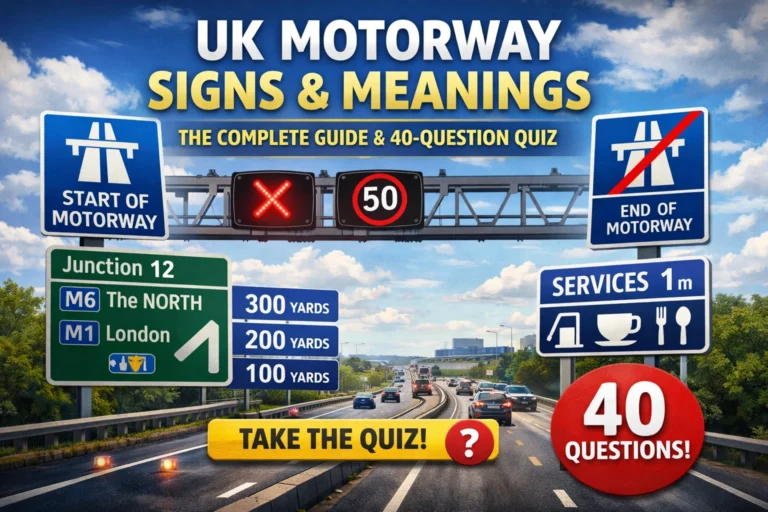
Test Your Knowledge: UK Motorway Signs Quiz
Before we dive into the deep end of motorway regulations, let’s see where you stand. Are you fully prepared for your theory test, or do the blue road signs still confuse you?
Challenge yourself with our interactive 40-question quiz below. It covers almost everything about UK Motorway Signs and Meanings. Give it your best shot, and then scroll down to read our comprehensive guide to understand exactly what every sign means.
Results
Congratulations! You passed! Great job on completing the quiz. You have a solid understanding of UK motorway signs and signals. Keep practicing to stay sharp and safe on the road!
You didn’t pass this time. Don’t worry! Read through the guide below to review the signs you missed, then try again. Practice makes perfect!


#1. What is the standard background color for most motorway signs?
Most motorway signs have a blue background with white lettering and borders.
#2. Which background color is used specifically for motorway tourist destination signs?
Tourist destination signs on motorways use a brown background.
#3. Which of these movements is strictly prohibited on a motorway?
Special regulations prohibit stopping (except emergencies), U-turns, and reversing.
#4. Which vehicle is prohibited from using the right-hand lane of a motorway with three or more lanes?
Goods vehicles and buses over 7.5 tonnes laden weight must not use the right-hand lane.
#5. What is the minimum unladen weight for an invalid carriage to be allowed on a motorway?
Invalid carriages of less than 254 kg unladen weight are prohibited from motorways.
#6. What is the minimum speed capability required for a vehicle to be allowed on a motorway?
Vehicles must be capable of attaining a speed of 25 mph on the level when unladen.
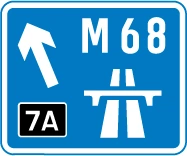
#7. How can you identify a motorway junction number on a sign?
Junctions are identified by a number shown on a black background in the corner of signs.
#8. If you miss your exit, you should:
You must never reverse or turn back; continue to the next junction.
#9. What is an “all-purpose road”?
A road other than a motorway is referred to as an ‘all-purpose road’.
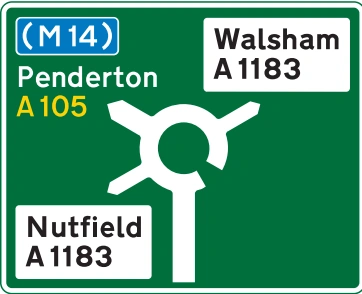
#10. What does a motorway number in brackets (e.g., (M14)) on a green sign indicate?
Brackets without the motorway symbol indicate the route to take to reach the motorway later.
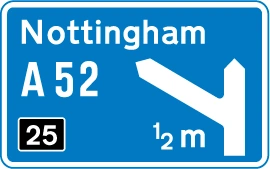
#11. At what standard distances are advance direction signs usually located before a junction?
Direction signs are usually located 1 mile and 1/2 mile in advance of the exit.
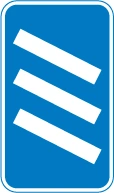
#12. What is indicated by a countdown marker with three white diagonal bars?
Each bar on a countdown marker represents approximately 100 yards.
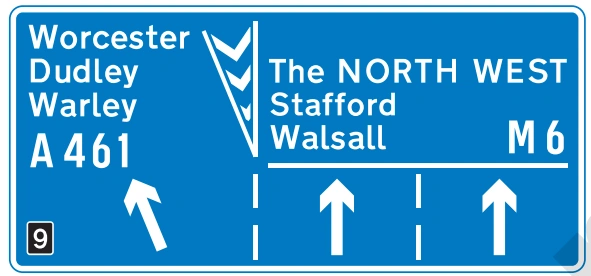
#13. What is a “lane drop” junction?
A lane drop is where a lane leaves the main carriageway to become the exit slip road.
#14. Why do lane-drop junctions NOT use countdown markers?
Countdown markers are for deceleration lanes; lane drops lead directly to the exit.
#15. What does a sign with an inclined arrow (pointing 45 degrees) usually indicate at a junction?
An inclined arrow sign is located just before a lane leaves the main carriageway.
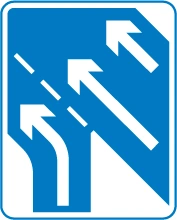
#16. What is a “lane gain”?
A lane gain occurs when a slip road joins to increase the total number of lanes.
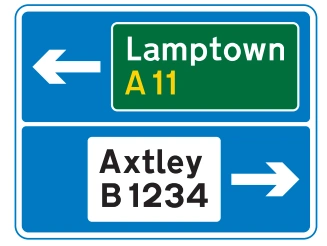
#17. On an exit slip road sign, what does a green panel indicate?
Green panels on direction signs indicate a primary route.
#18. On an exit slip road sign, what does a white panel indicate?
White panels indicate a non-primary route.
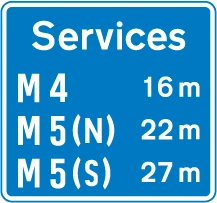
#19. What is the typical interval between motorway service areas?
Service areas are generally provided at intervals of not more than 30 miles.
#20. Motorway service areas are mandatory to be open during which times?
Service areas are open 24 hours a day, every day of the year.
#21. What is the minimum period of free parking required at a motorway service area?
Service areas must provide free parking for up to 2 hours.
#22. What does the “bed” symbol on a motorway service sign represent?
The bed symbol indicates that overnight accommodation is available.
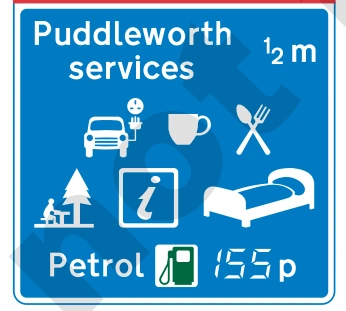
#23. What does the ‘i’ symbol on a service sign refer to?
The ‘i’ symbol refers to a tourist or general information point.
#24. What does a green pump symbol with a price (e.g., 155p) indicate?
The green pump symbol indicates the price for a litre of unleaded petrol.
#25. What is a “truckstop”?
A truckstop provides parking, food, toilets, and fuel 24/7 for the whole year.
#26. How long can you park for free at a “Rest Area”?
Like service areas, rest areas provide free parking for up to 2 hours.
#27. What color is used for marker posts that show the direction to an emergency telephone?
Emergency telephones are housed in orange boxes, and marker posts point toward them.
#28. How often are emergency telephone marker posts located on the hard shoulder?
Marker posts are located at approximately 100-metre intervals.
#29. What is the purpose of special chevron markings painted 40m apart on some motorways?
Keeping two chevrons between you and the car in front ensures a safe gap.
#30. At 70 mph, how many chevrons should you keep between your vehicle and the one in front?
Keeping two marks between vehicles provides a safe distance at 70 mph.
#31. What do red flashing lights above your lane mean?
Red lights flashing in pairs with a red cross mean do not proceed in that lane.
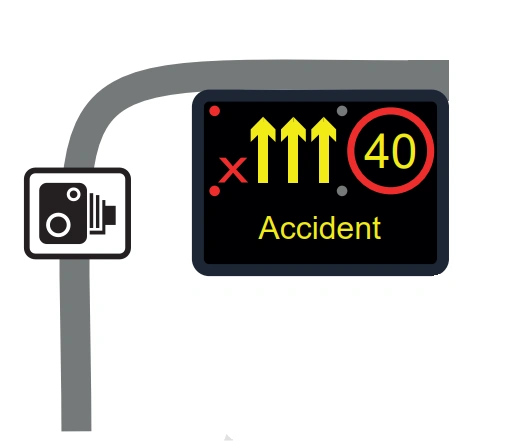
#32. What does a red cross (X) on an overhead signal mean?
A red cross identifies a closed lane that you must not drive in.
#33. If a speed limit is shown in a red circle on a variable sign, is it mandatory?
Speed limits shown in a red circle are mandatory.

#34. What do flashing amber lights on an older type of motorway signal indicate?
Flashing amber lights warn of a hazard; you should not exceed 30 mph until past it.
#35. What color are “emergency areas” on motorways without a hard shoulder?
Emergency areas are painted orange to make them highly visible.
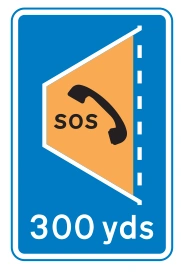
#36. What MUST you do before rejoining the motorway from an emergency area?
You must use the emergency telephone and follow advice to rejoin safely.

#37. On these motorway signals, what does the ‘T’ symbol represent?
The ‘T’ shape on these matrix signs is used to indicate that a specific lane is closed to traffic
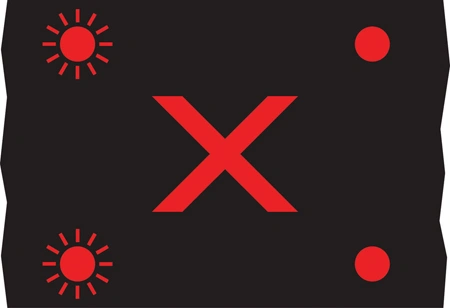
#38. What should you do if red lights are flashing in pairs from side to side at a motorway entrance?
Do not enter the motorway when red lights are flashing in pairs.
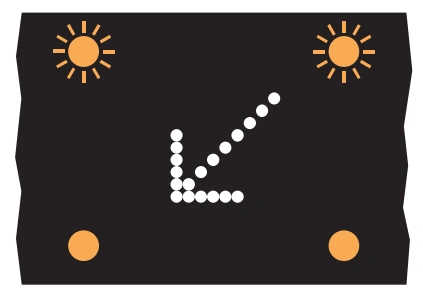
#39. What does a motorway signal showing a white diagonal arrow pointing downwards mean?
This signal directs drivers to move to the adjacent lane (the arrow may point downwards to the left or right) to avoid a hazard or lane closure ahead

#40. What does the word “End” on a motorway signal indicate?
“End” signifies the end of temporary restrictions or that a lane is no longer closed.
Introduction to UK Motorway Signage
Driving on a motorway for the first time can be daunting. With high speeds and multiple lanes, understanding the visual language of the road is critical. UK motorways have a specific “language,” primarily defined by blue rectangular signs with white text.
Unlike local roads, where green or white signs might dominate, the motorway network relies on these distinct blue signs to give you high-speed information quickly. Understanding these signs isn’t just about avoiding a wrong turn; it is vital for your safety and is a massive part of passing the DVSA theory test and the practical driving test.
The Meaning of Colours and Shapes on the Motorway
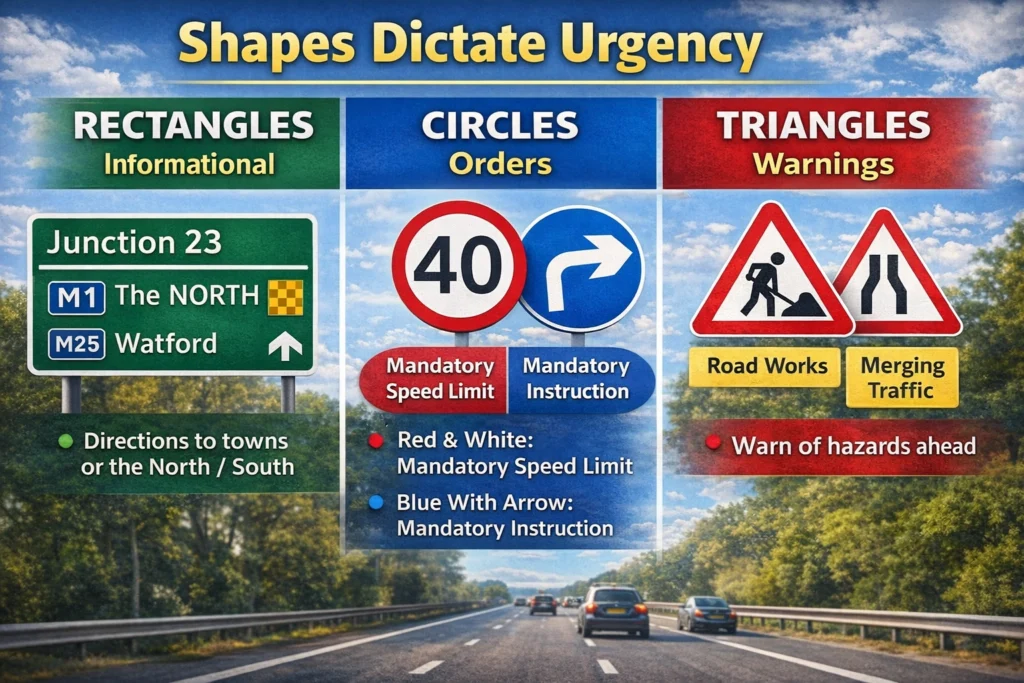
To react quickly at 70mph, you need to understand the psychology behind the signage. The Highway Code uses specific shapes and colours to tell you what you are looking at before you even read the text.
Why are Motorway Signs Blue?
In the UK, blue road signs are used to indicate “Information” and “Directions” on motorways. If you see a blue background, you are on a motorway (or a road with motorway regulations). This distinguishes them from Primary Routes (Green) and Non-Primary Routes (White). When you see blue, assume standard motorway rules apply unless signs say otherwise.
Rectangles, Circles, and Triangles
A quick refresher on how shapes dictate the “urgency” of the message:
- Rectangles: Informational. These give you directions to towns, cities, or the North/South.
- Circles: Orders. A number in a red circle is a maximum speed limit (mandatory). A blue circle with an arrow is a mandatory instruction (e.g., “keep left”).
- Triangles: Warnings. These warn you of hazards ahead, such as road works or merging traffic.
Want to learn more? Try our 20+ red warning road signs practice quiz.
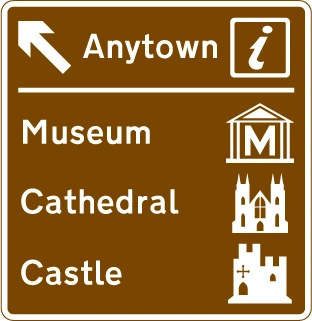
What do brown signs on the motorway mean?
Signs with a brown background are specifically used to identify tourist attractions and historical landmarks. Distinct from standard route signage, these boards are designed to assist leisure travellers by pointing out recreational destinations—such as museums, zoos, theme parks, and heritage sites—that are accessible via the upcoming junction.
Essential Motorway Entry and Exit Signs
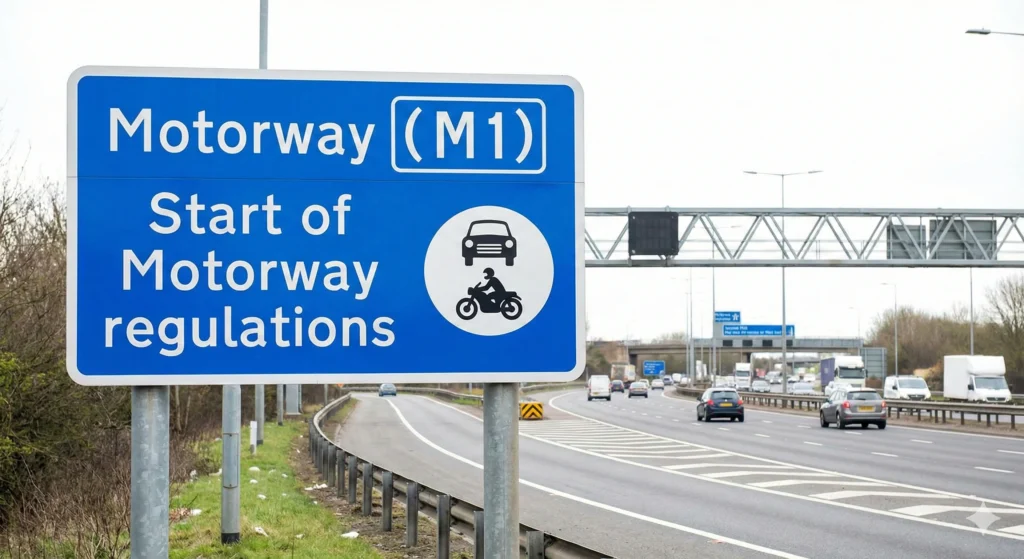
Knowing when you are entering or leaving high-speed regulations is crucial for avoiding fines and staying safe.
The Start of Motorway Sign
You will know you are entering a motorway when you see the “Start of Motorway” sign. This is a blue rectangular sign featuring the motorway symbol (a simplified drawing of a bridge over a road) and the motorway number (e.g., M1, M25). Once you pass this sign, motorway regulations—such as no stopping and no pedestrians—are in effect.
The End of Motorway Sign
One of the most searched queries for new drivers is the end of motorway sign UK. This sign is critical because it signals a drastic change in road rules.
The sign appears as the standard motorway symbol with a red diagonal strike-through across it.
- Meaning: Motorway regulations end immediately.
- Action: You must check your speedometer. The road ahead may drop to a 60mph, 50mph, or even 30mph limit rapidly. Failing to spot this sign is a common cause of speeding tickets for drivers exiting onto local dual carriageways.
Countdown Markers
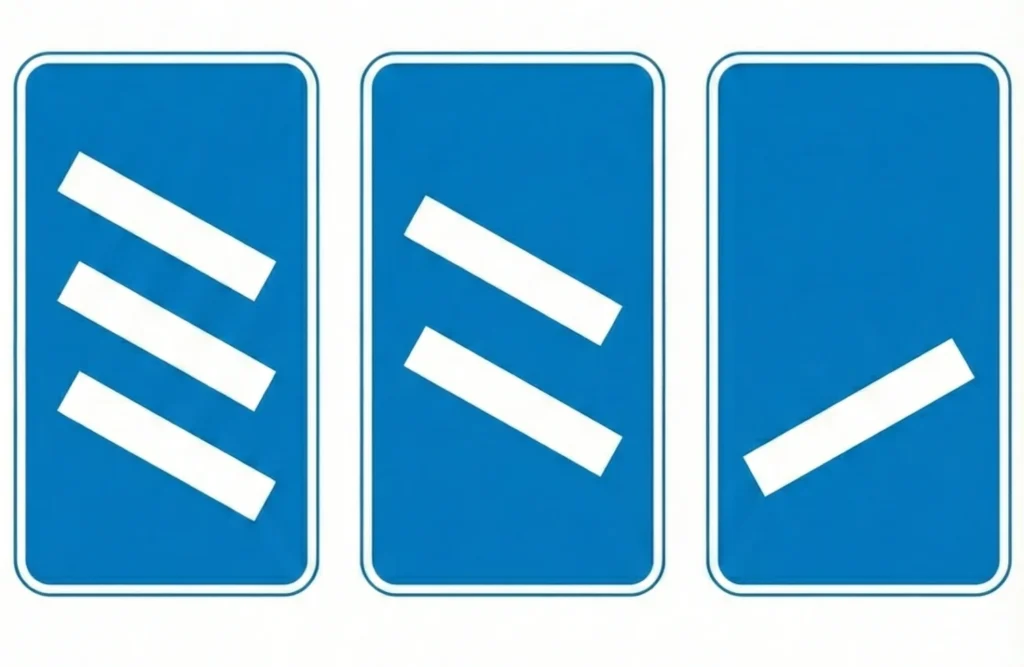
As you approach an exit, you will see motorway countdown markers. These are blue rectangular bars placed on the left-hand side of the road:
- 3 Bars: 300 yards to the exit.
- 2 Bars: 200 yards to the exit.
- 1 Bar: 100 yards to the exit.
You should be indicating left by the time you reach the 300-yard marker.
Navigating Junctions and Directions
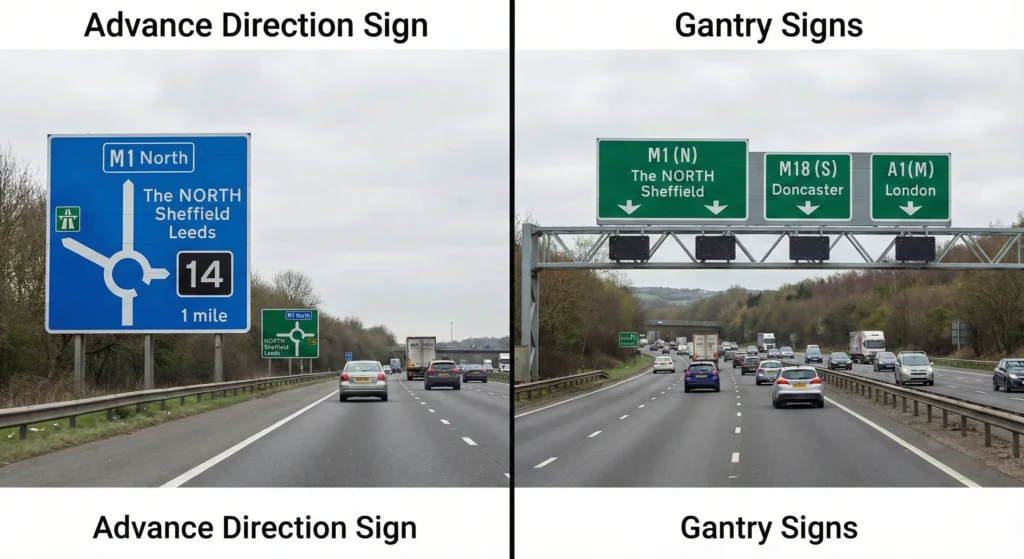
Advance Direction Signs
Approximately one mile before a junction, you will see a large map-style sign. The key feature here is the Junction Number, displayed as a white number in a black box (e.g., J14). Memorizing junction numbers is often easier than memorizing destination names when following a sat-nav.
Gantry Signs
On busy sections of the motorway, gantry signals are mounted overhead. These provide lane-specific directions. If a destination is shown with an arrow pointing directly down at a specific lane, you must be in that lane to go that way.
Motorway Service Areas (MSA) Signs
Fatigue is a major killer on UK roads. The Highway Code recommends a 15-minute break every two hours.
Advance Warning Signs
You will typically see signs reading “Services ½ m” or “Services 1m” well in advance. These signs often list the current fuel price and the operator brands (e.g., Costa, Burger King) so you can decide if you want to stop.
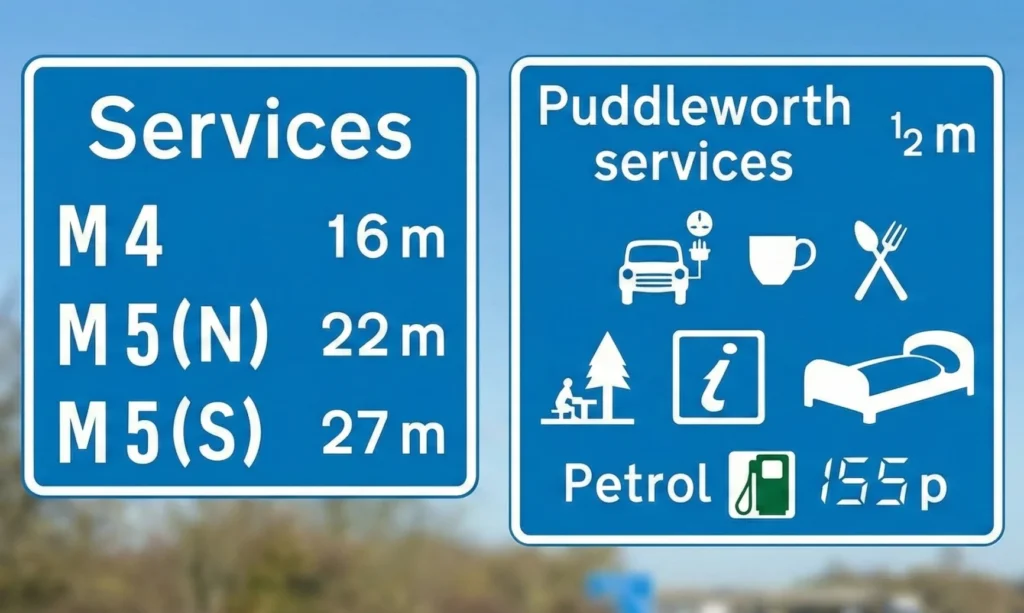
Symbols to Look For
Service signs use universal icons to help you scan quickly:
- Fuel Pump: Petrol/Diesel available.
- Cup: Hot drinks/Coffee.
- Fork and Spoon: Hot food/Restaurant.
- Bed: Lodge or Hotel accommodation.
- Electric Vehicle (EV) Symbol: Charging points available.
Distance to Next Services
Crucially, service signs will often tell you the distance to the following service area (e.g., “Next Services 24 miles”). If you are low on fuel or need a bathroom break, this information helps you decide whether to stop now or risk the drive to the next one.
Smart Motorway Signals (Safety & Law)
Smart motorway signals and meanings are a frequent topic of confusion, but they are legally enforceable.
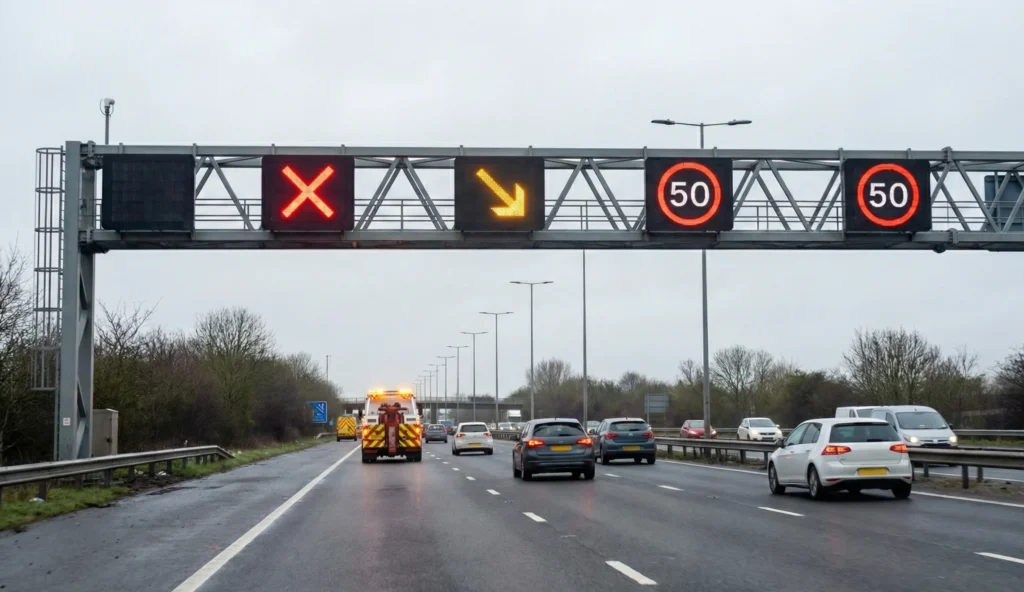
The Red X Signal
The Red X lane closure signal is perhaps the most important safety sign on a smart motorway.
- Meaning: The lane is closed, usually due to a breakdown or accident ahead.
- Action: You must move out of the lane as soon as it is safe to do so.
- Penalty: Driving in a Red X lane is illegal and dangerous; cameras can automatically issue fines and points on your license.
Variable Speed Limits
Unlike standard motorways with a fixed 70mph limit, smart motorways use variable speed limits displayed in red circles on overhead gantries (e.g., 50 or 60). These are mandatory. If the ring around the number is red, the speed camera is active.
Information Messages
The electronic matrix signs can also display text warnings like “Fog,” “Queue Ahead,” “Debris in Road,” or “High Winds.” These are advisory but should be taken seriously to avoid accidents.
Emergency and Location Signs
If you break down, you need to know exactly where you are to get help.
Driver Location Signs
You will see small blue signs with yellow lettering roughly every 500 meters (often on the hard shoulder or verge). These are Driver Location Signs. They contain:
- The road name (e.g., M1).
- The carriageway identifier (A or B).
- A precise location number. Giving this number to emergency services allows them to pinpoint your location instantly.
Emergency Areas and SOS Telephones
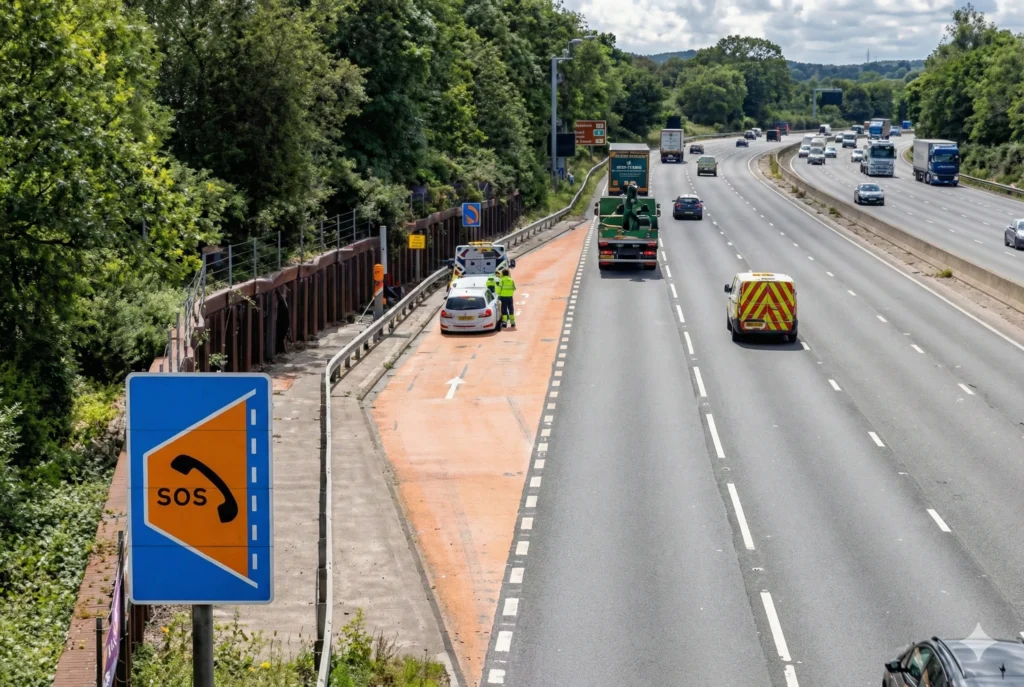
On “All Lane Running” smart motorways where there is no hard shoulder, you must aim for an Emergency Area (SOS). These are lay-bys marked with orange road surfacing and blue signs with an orange SOS phone symbol.
Frequently Asked Questions (FAQ)
What is the speed limit on a motorway if no signs are present?
For standard cars and motorcycles, the default national speed limit is 70 mph. This applies whenever standard motorway regulations are in force and no specific numerical limit is displayed. However, you must always adhere to variable speed limits shown on overhead gantries (common on Smart Motorways), which legally override the default limit.
What do the signs with diagonal bars mean?
These blue rectangular signs serve as a countdown to an exit. They are spaced 100 yards apart starting from the exit slip road. The sign with three bars indicates you are 300 yards away, two bars means 200 yards, and one bar means 100 yards. Drivers should typically use these markers as a guide for when to start signaling and safely reducing speed.
When are you allowed to stop on the hard shoulder?
Stopping on the hard shoulder is illegal unless you are experiencing a genuine emergency, a breakdown, or are directed to pull over by the police or a traffic officer. You must never use the hard shoulder to make a phone call, check navigation, or take a break; for these non-emergencies, you must drive to the nearest Motorway Service Area (MSA) or leave the motorway at the next exit.
Can learner drivers go on the motorway?
Yes, but only if they are accompanied by an approved driving instructor in a car fitted with dual controls. Learner motorcyclists are not allowed on motorways.