
Passing the theory test isn’t just about memorising road signs; it is about understanding how to keep your car legal and safe. The safety and your vehicle theory test category is one of the most practical sections of the DVSA syllabus.
In 2026, vehicle technology is advancing, but the core principles of maintenance remain the same. This guide breaks down exactly what you need to know to ace the UK theory test safety vehicle quizzes and become a responsible driver.
Move to QuizWhat Does “Safety and Your Vehicle” Mean in the UK Theory Test?
This category focuses on your knowledge of vehicle maintenance, legal requirements, and how to detect potential faults before they become dangerous. The DVSA theory test vehicle safety section ensures you understand that a driver’s responsibility extends beyond just steering the wheel—it includes the mechanical condition of the car.
Why DVSA Tests Vehicle Safety Knowledge
The Driver and Vehicle Standards Agency (DVSA) includes these questions to ensure you:
- Know how to spot dangerous faults (like bald tyres or faulty brakes).
- Understand your legal responsibility to maintain the vehicle.
- Can interpret warning lights and vehicle handling issues.
- Know the basics of the Highway Code regarding vehicle condition.
Typical Volume: You can expect roughly 4–6 questions from this category in your 50-question test, but knowledge here overlaps significantly with Hazard Perception.
Safety and Your Vehicle Theory Test 2026 – What to Expect
The 2026 test format continues to rely on multiple-choice questions, but they are increasingly scenario-based.
- Question Style: You might see a photo of a dashboard warning light and be asked what it signifies, or read a scenario about a car pulling to one side while braking.
- Common Traps: Many learners confuse “advisable” actions with “legal” requirements. For example, carrying a spare tyre is advisable, but having sufficient tread on your fitted tyres is a legal requirement.
- Hazard Perception Link: Poor vehicle maintenance (like dirty windows or blown bulbs) directly affects your ability to spot hazards.
Vehicle Safety Essentials (Most Tested Area)
This section covers the mechanical knowledge you must memorise. These are the specific facts and figures the DVSA loves to test.
Tyres and Wheels (Very High Priority)
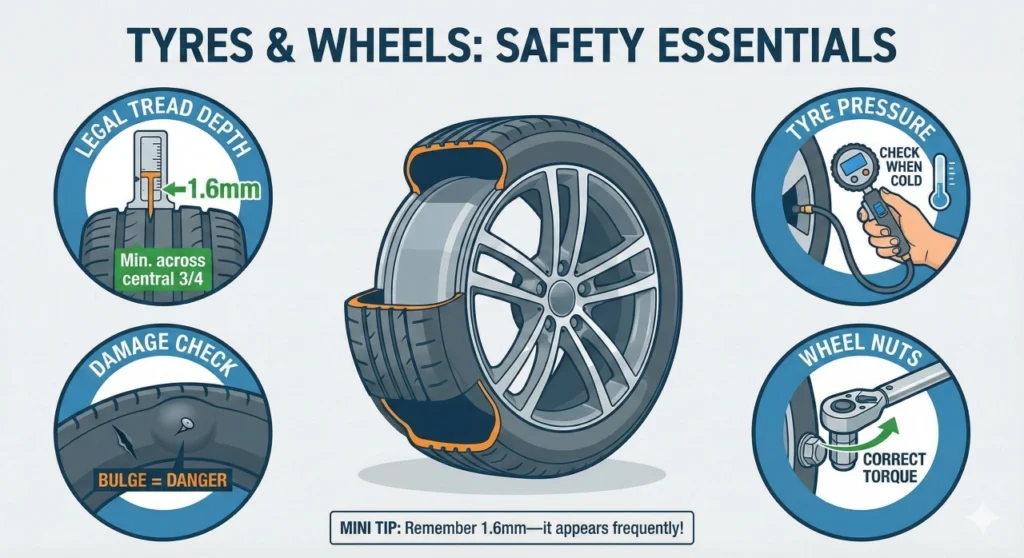
Basically, tyres are the only contact between you and the road. If they fail, you lose control.
- Legal Tread Depth: The minimum legal tread depth for cars in the UK is 1.6mm. This must cover the central three-quarters of the breadth of the tyre and around the entire circumference.
- Tyre Pressure: Check pressures when tyres are cold (before a long journey). Warm tyres give false high readings. Incorrect pressure can affect braking and steering.
- Damage: Look for cuts, nails, or bulges in the sidewall. A bulge usually suggests internal structural damage and could lead to a blowout.
- Wheel Nuts: Ensure they are tightened to the correct torque.
Mini Tip: Tyres are one of the most failed areas in the theory test. Remember the number 1.6mm—it appears frequently!
Brakes, Steering and Suspension
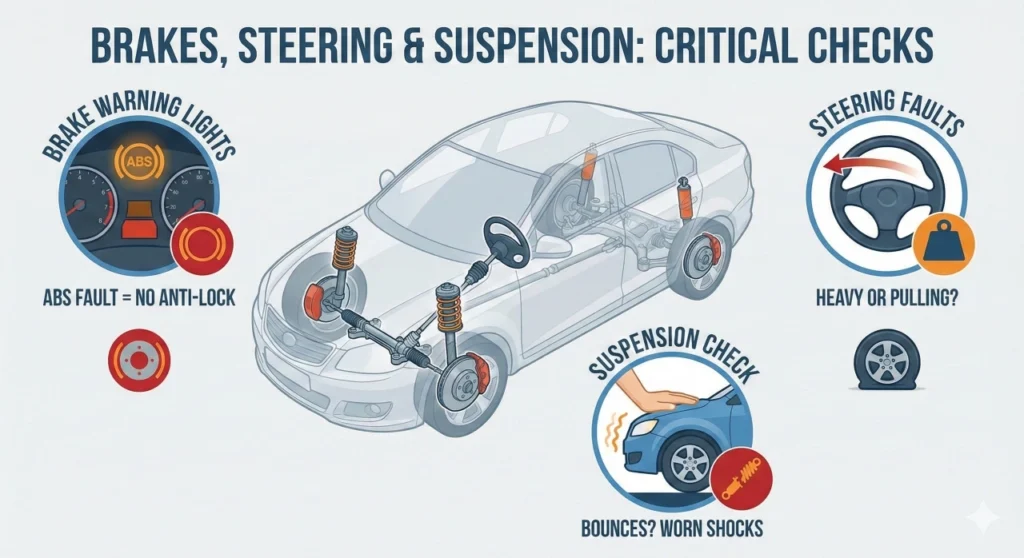
- Brake Warning Lights: If the ABS (Anti-lock Braking System) warning light stays on, the system is faulty. Your normal brakes will work, but the anti-lock feature will not.
- Steering Faults: If your steering feels “heavy” or the car pulls to one side, you may have a puncture or a mechanical steering fault.
- Suspension: If you press down on the front wing of the car and it continues to bounce, your shock absorbers are likely worn.
Engine Oil, Coolant and Other Fluids
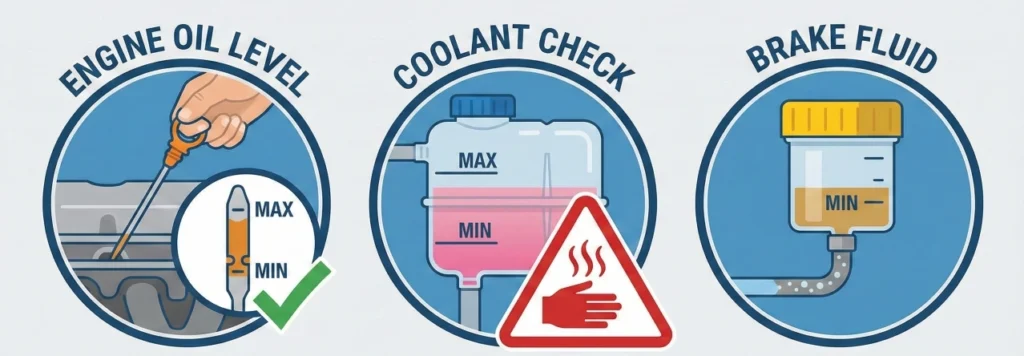
- Engine Oil: Check this using the dipstick. The level should be between the ‘min’ and ‘max’ markers. Low oil can seize the engine.
- Coolant: Check the reservoir level. Never remove the radiator cap when the engine is hot—you risk severe scalding.
- Brake Fluid: If this falls below the minimum mark, air can enter the brake lines, causing brake failure.
Lights, Indicators and Reflectors
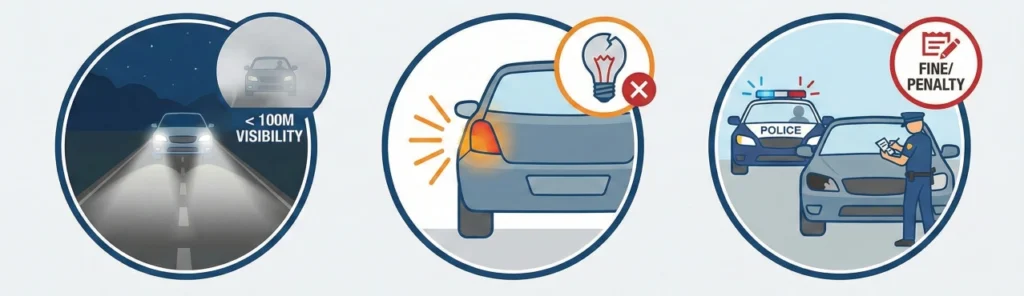
- Usage: You must use headlights at night and when visibility is seriously reduced (generally less than 100 metres).
- Faults: A rapidly flashing indicator usually means the bulb on that side has blown.
- Legal Consequence: Driving with a broken headlight is illegal and dangerous.
Horn, Exhaust and Catalytic Converter
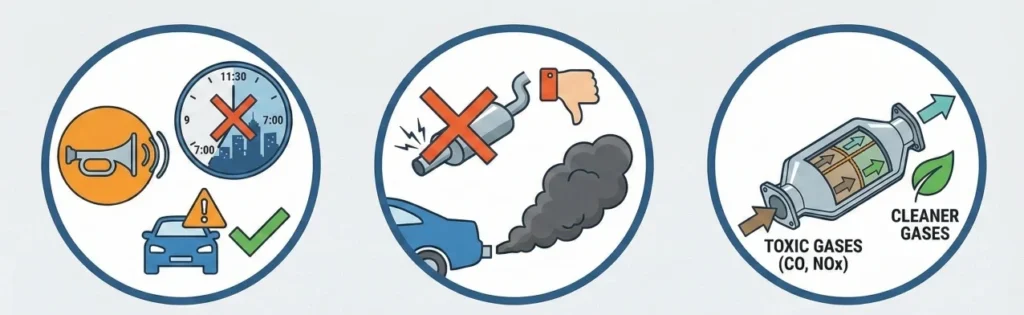
- Horn: Use it only to warn others of your presence. You must not use it between 11:30 pm and 7:00 am in built-up areas, unless stationary and another vehicle poses a danger.
- Exhaust: A noisy exhaust is illegal. Dark smoke indicates engine wear and excessive emissions.
- Catalytic Converter: This device is fitted to the exhaust system to reduce toxic gas emissions (carbon monoxide) and nitrogen oxides.
Battery, Electrics and General Maintenance
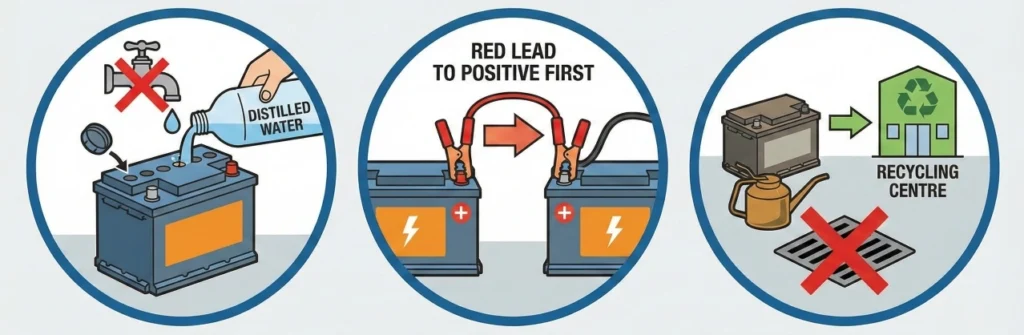
- Battery: If the battery is old and requires maintenance, you may need to top it up with distilled water (not tap water) just above the cell plates.
- Jump-Starting: Always connect the red lead to the positive terminal first.
- Disposal: Old batteries and oil are hazardous waste and must be disposed of at a local recycling centre, not down the drain.
📊 Table 1: Vehicle Safety Checks You Must Know (Theory Test Focus)
| Vehicle Part | What Checks | Why Matters |
| Tyres | Tread depth (1.6mm) & pressure | Improves grip and reduces skidding and aquaplaning |
| Brakes | Fluid levels & warning lights | Ensures safe stopping distances |
| Oil | Dipstick level (min/max) | Prevents engine damage & damage |
| Lights | Working order & cleanliness | Safe visibility and meets legal rules |
| Exhaust | Smoke colour & noise | Controls emissions & detects faults |
Driver Behaviour and Vehicle Safety
Your vehicle is only as safe as the person operating it. This section covers how you prepare yourself and the car for the road.
Route Planning and Vehicle Preparation
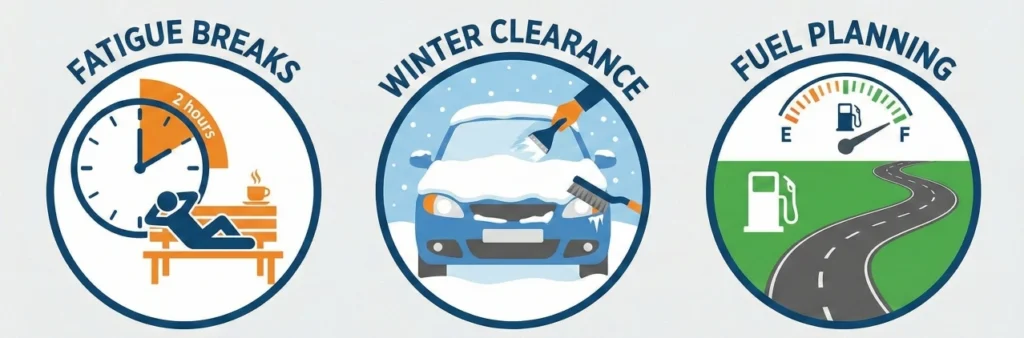
- Fatigue: Plan for a break of at least 15 minutes every two hours.
- Weather: In winter, clear all snow and ice from windows, mirrors, and lights before driving.
- Fuel: running out of fuel is avoidable; ensure you have enough for your journey to prevent breakdowns on high-speed roads.
Vehicle Security and Anti-Theft Safety
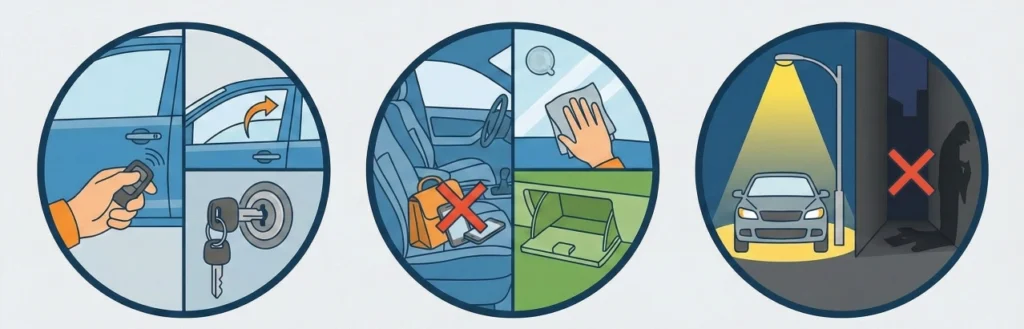
- Leaving the Vehicle: Always lock doors, close windows, and remove the keys, even if you are just paying for fuel.
- Valuables: Never leave bags, phones, or Sat Navs on display. Remove the suction mark from the windscreen—it tells thieves a Sat Nav might be in the glovebox.
- Parking: At night, park in well-lit areas.
Parking Safety and Responsibility
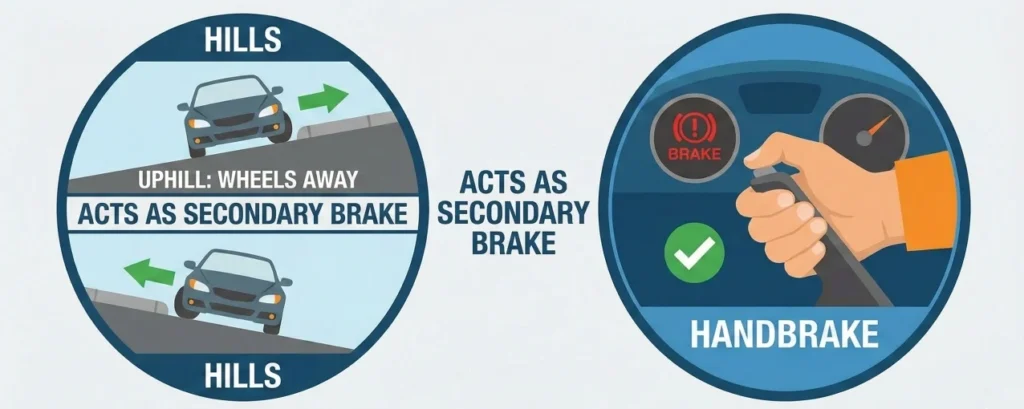
- Hills: When parking facing uphill, turn the steering wheel away from the kerb. When facing downhill, turn it towards the kerb. This acts as a secondary brake.
- Handbrake: Ensure it is firmly applied.
Road Humps, Chicanes and Narrow Roads
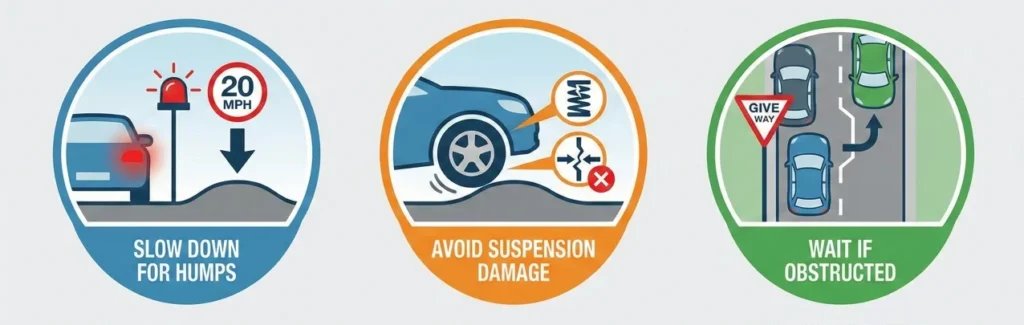
- Speed: Road humps are traffic calming measures. Slow down before you reach them.
- Suspension: Taking humps too fast can damage your suspension and alignment.
- Priority: In chicanes (narrowing roads), signs will indicate who has priority. If the obstruction is on your side, you must wait.
Seat Belts, Footwear and Child Restraints (Highly Tested)
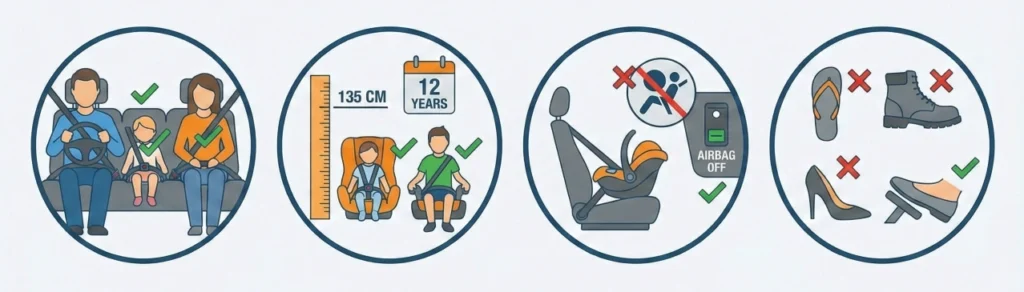
- Adults: The driver is responsible for ensuring themselves and any passenger under 14 wears a seatbelt. Passengers over 14 are personally responsible.
- Children: Children must use a suitable child restraint until they are either 135cm tall or 12 years old (whichever comes first).
- Rear-facing seats: You must deactivate the passenger airbag if placing a rear-facing baby seat in the front passenger seat.
- Shoes: Avoid flip-flops, heavy boots, or high heels. You need shoes that provide good grip and allow you to feel the controls clearly. Driving barefoot is not illegal but is generally not recommended if it reduces your control.
Environmental Issues and Eco-Safe Driving
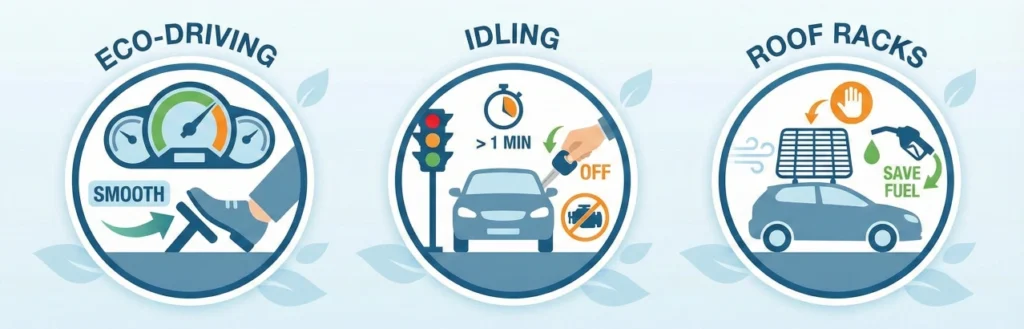
- Eco-Driving: Drive smoothly. Avoid rapid acceleration and harsh braking.
- Idling: Switch off your engine if you are likely to be waiting for more than a minute (e.g., at a level crossing).
- Roof Racks: Remove them when not in use to reduce wind resistance (drag) and save fuel.
📊 Table 2: Driver Responsibilities Related to Vehicle Safety
| Responsibility | Theory Test Focus |
| Seat belts | Legal compliance (Driver liable for under 14s) |
| Child seats | Age (12) & height (135cm) rules |
| Parking | Safety & legality (Wheel direction on hills) |
| Vehicle security | Theft prevention (Remove Sat Nav marks) |
| Eco-driving | Environmental impact (Reduce drag & idling) |
Common “Safety and Your Vehicle” Theory Test Mistakes
Learners often drop marks here because the questions can be specific. Watch out for these:
- Tyre Confusion: Don’t mix up tyre pressure (check when cold) with tread depth (1.6mm).
- Fog Lights: Many forget that rear fog lights must be switched off once visibility improves to avoid dazzling drivers behind you.
- Child Seat Rules: Confusing the height limit (135cm) with other numbers.
- Horn Usage: Forgetting the time restriction (11:30 pm – 7:00 am) in built-up areas.
Now Test Your Knowledge: Safety and Your Vehicle Quiz
You have read the rules, checked the tyre limits, and learned the warning lights. Now, it is time to see if you are ready for the real DVSA theory test.
We have put together 20 mock questions of Safety and Your Vehicle Theory based on the official 2026 syllabus to help you identify any weak spots. These questions cover everything from tyre tread depth to essential fluid checks.
Results


#1. What is the legal minimum tread depth for car tyres in the UK?
The legal minimum tread depth for cars in the UK is 1.6 mm across the central three-quarters of the tyre.
#2. When is the best time to check your tyre pressures?
You should check tyre pressures when they are cold to get an accurate reading. Heat from driving increases pressure.
#3. What fluid should you use to top up a car battery?
If a battery is not maintenance-free, it should be topped up with distilled water to just above the cell plates.
#4. What does it indicate if your vehicle pulls to one side when you brake?
If the car pulls to one side, there may be a mechanical fault in the braking system or the wheel alignment.
#5. How can you test if your shock absorbers are worn?
Push down hard on each corner of the car. If it bounces more than once or twice, the shock absorbers may be worn.
#6. You are carrying a 5-year-old child. Who is legally responsible for ensuring they wear a seat belt?
The driver is legally responsible for ensuring all passengers under 14 years old wear a seat belt or suitable restraint.
#7. What is the main purpose of a head restraint?
Head restraints help prevent whiplash and neck injuries in the event of a rear-end collision.
#8. What should you do if your anti-lock brakes (ABS) warning light stays on?
An ABS light indicates a fault with the anti-lock system. The normal brakes will work, but ABS will not function in an emergency.
#9. Turning the steering wheel while the car is stationary is known as ‘dry steering’. Why should you avoid it?
Dry steering puts unnecessary strain on the steering mechanism and causes excessive wear to the tyres.
#10. Up to what age or height must a child use a suitable car seat?
Children must use a child seat until they are 12 years old or 135 cm tall, whichever comes first.
#11. Why is it important to remove a roof rack when it is not being used?
An empty roof rack increases wind resistance (drag), which forces the engine to work harder and use more fuel.
#12. What is the purpose of a catalytic converter?
A catalytic converter filters exhaust gases to reduce harmful emissions like carbon monoxide.
#13. When filling up your car, what happens if the fuel cap is left loose?
Spilled fuel (especially diesel) makes the road surface very slippery and dangerous for other road users, especially motorcyclists.
#14. What should you do if your steering wheel vibrates at high speeds?
Vibration in the steering wheel usually indicates that the wheels are unbalanced or the tracking is out of alignment.
#15. When should you use your parking lights?
You must leave parking lights on if you park on a road or lay-by with a speed limit greater than 30 mph at night.
#16. What is the risk of driving with under-inflated tyres?
Under-inflated tyres reduce grip and stability, increasing the risk of skidding and affecting braking performance.
#17. Why should you not remove the radiator cap when the engine is hot?
The cooling system is pressurised. Removing the cap when hot can cause boiling liquid and steam to release explosively.
#18. How often should you check your engine oil level?
You should check oil levels regularly, especially before long journeys, to prevent engine damage.
#19. You see a warning light on the dashboard that looks like a battery. What does it mean?
The battery warning light indicates a fault in the charging system (usually the alternator), meaning the battery is not being charged.
#20. What will happen if you put too much oil in your engine?
Overfilling the engine oil can create excessive pressure, leading to blown seals and oil leaks.
Theory Test Revision – How to Practise This Topic Effectively
- Category-Based Mock Tests: Most apps allow you to select specific topics. Filter by “Safety and Your Vehicle” and do 20 questions in a row.
- Revise Weak Areas: If you keep getting the tyre tread question wrong, write “1.6mm” on a sticky note and put it on your mirror.
- Combine with Hazard Perception: When watching hazard clips, look for cars with defects (e.g., one headlight out) to train your brain to spot mechanical risks.
Safety and Your Vehicle Theory Test Tips (DVSA Style)
To ensure you pass this section in 2026, adopt a “Safety First” mindset.
- Spot Trick Wording: If a question asks what you must do, look for a legal requirement (e.g., tread depth). If it asks what you should do, look for best practice advice (e.g., carry a first aid kit).
- Link to Highway Code: Every correct answer is rooted in the Highway Code. If an answer suggests ignoring a warning light or delaying a check, it is wrong.
- Read Carefully: Does the question say “Engine Oil” or “Brake Fluid”? The checking method differs!
Quick Summary – Key Points to Remember
- Responsibility: Vehicle safety is your legal responsibility as the driver, not the mechanic’s.
- The Big Three: Tyres (1.6mm), Seat belts (under 14s rule), and Warning lights (ABS) are the highest priority topics.
- Routine: Regular checks = safer driving + a much higher chance of passing your theory test.