
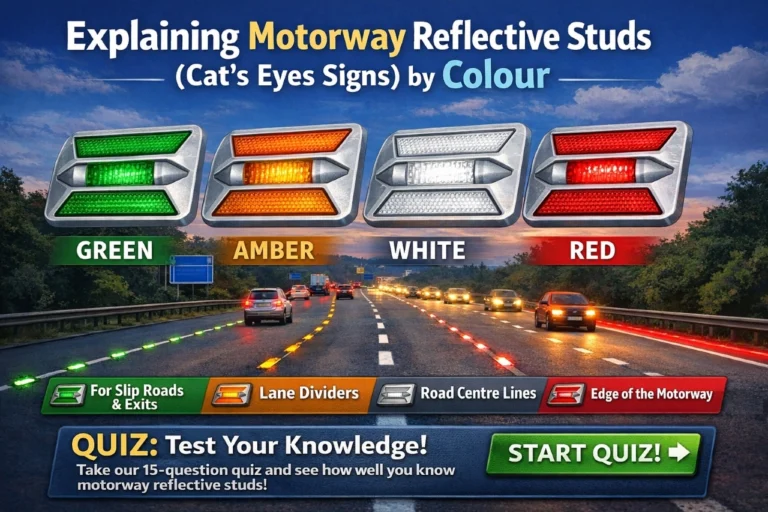
Driving on a UK motorway at night can be daunting, especially when visibility drops. That is where motorway reflective studs, affectionately known as “Cat’s Eyes,” become a driver’s best friend. These ingenious little devices capture the light from your headlamps and reflect it back, mapping out the road ahead.
For learner drivers and seasoned motorists alike, understanding motorway studs colours meaning is vital. It isn’t just about passing the theory test; it is about staying safe. In this guide, we break down exactly what each colour signifies on UK roads and why reflective studs UK laws require them.
If you already have experience, you can skip the guide and go straight to the quiz.
Move to QuizWhat Are Motorway Reflective Studs?
Reflective road studs are retro-reflective safety devices embedded into the road surface. Their primary job is to mark the lanes and edges of the road, guiding drivers when painted lines become difficult to see.
A British Invention
You can’t discuss these studs without a nod to their history. They were invented in 1933 by Percy Shaw of Halifax, West Yorkshire. Legend has it he was inspired by the reflection of his headlamps in the eyes of a cat sitting on a fence—hence the nickname “Cat’s Eyes.”
Where Are They Found?
While you will occasionally see them on unlit country roads to mark the centre line, they are a staple feature on:
- Motorways (e.g., M1, M25)
- Dual Carriageways
- Complex Slip Roads
Why Reflective Stud Colours Matter
Why do we have different colours? It isn’t for decoration. The colour of the stud acts as a visual code that communicates your position on the road instantly.
- Lane Discipline: They help drivers identify lanes and road edges in the dark without needing overhead lighting.
- Adverse Weather: They drastically improve safety in fog, heavy rain, and spray, where white painted lines might vanish.
- Theory Test Success: Interpreting cat’s eyes signs and studs is a frequent topic in the UK Driving Theory Test.
Motorway Reflective Stud Colours and Their Meanings
To drive safely, you must know what each colour represents. Here is the definitive breakdown of UK road studs.
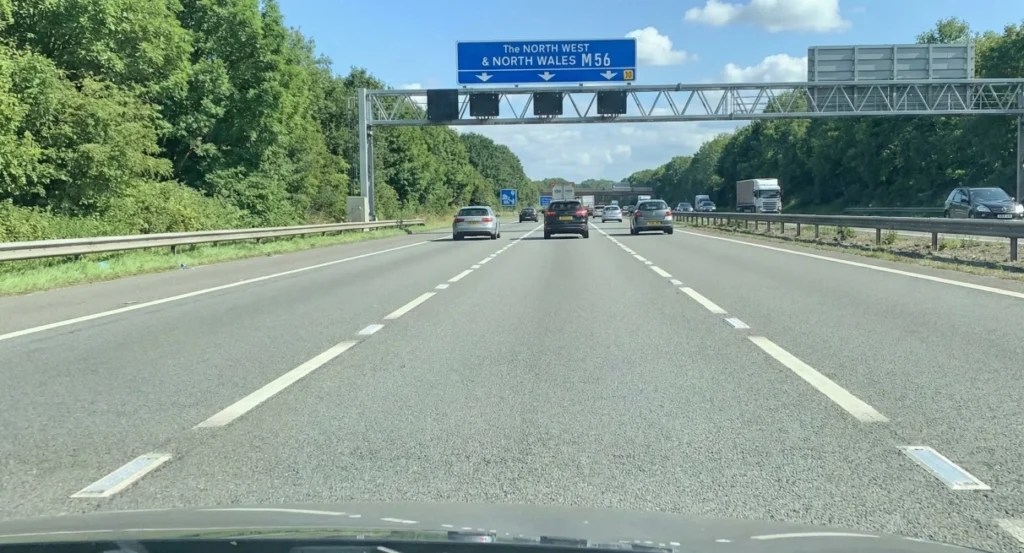
White Reflective Studs
Location: Between lanes.
Meaning: White studs separate lanes travelling in the same direction. You will see these in the middle of the motorway, marking the division between Lane 1, Lane 2, and Lane 3. If you are crossing white studs, you are changing lanes.
Red Reflective Studs
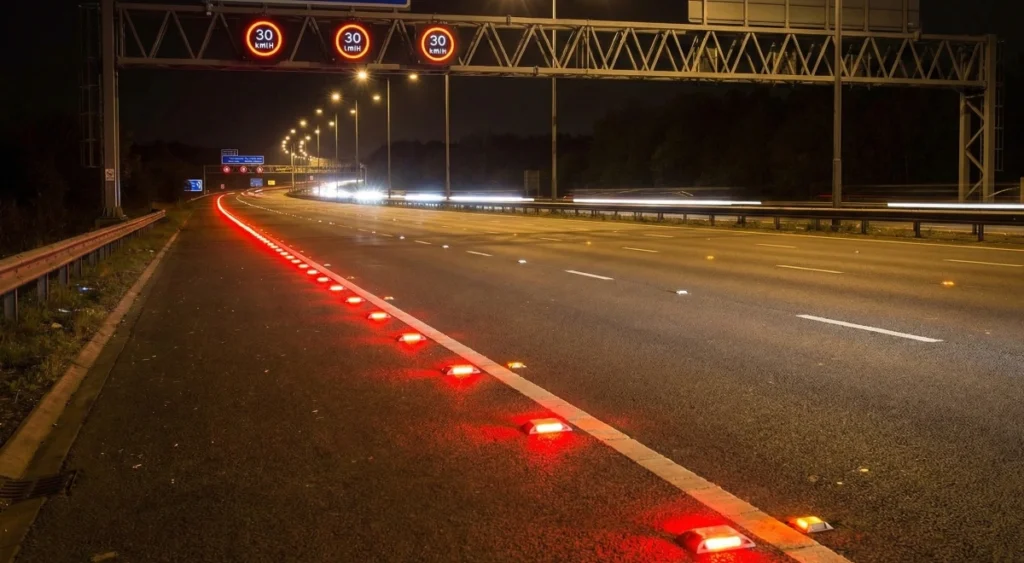
Location: Left edge of the carriageway.
Meaning: Red studs act as a warning. They mark the boundary between the driving lane (Lane 1) and the hard shoulder or the verge.
- Rule of thumb: You should strictly keep to the right of red studs unless there is an emergency or you are directed by police/traffic officers.
Test your knowledge further with our dedicated red road sign quiz.
Amber Reflective Studs
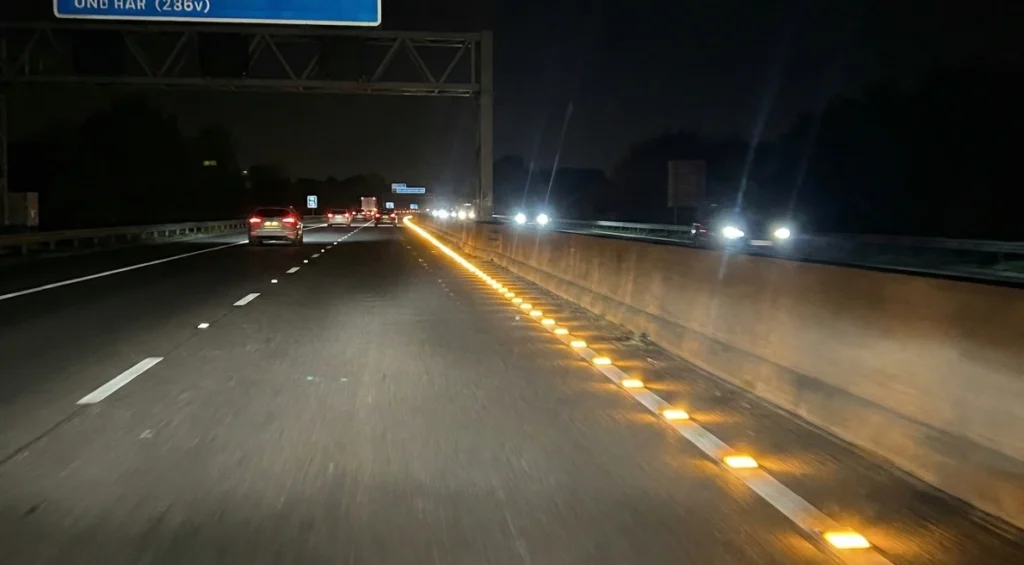
Location: Right edge of the carriageway.
Meaning: These are found next to the central reservation (the barrier separating opposing traffic). They tell you that you are in the outermost overtaking lane and firmly mark the limit of the road on the right-hand side.
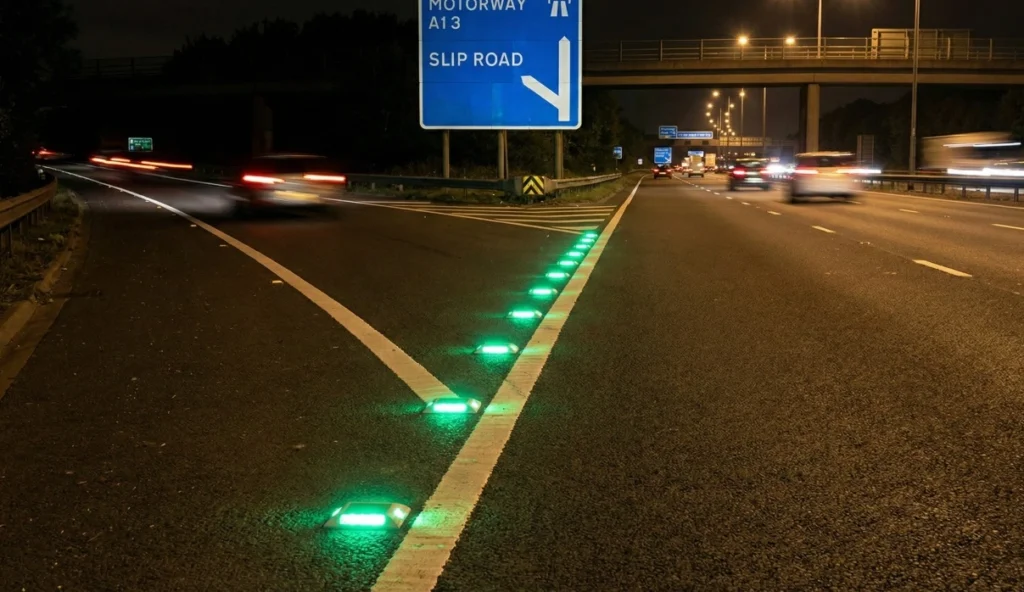
Green Reflective Studs
Location: Slip roads, junctions, and lay-bys.
Meaning: Green studs mark entry and exit points. You will see a line of green studs crossing the hard shoulder where a slip road joins or leaves the motorway.
- Why it matters: They indicate that the lane layout is changing and help you guide your vehicle safely into a deceleration lane or out of an acceleration lane.
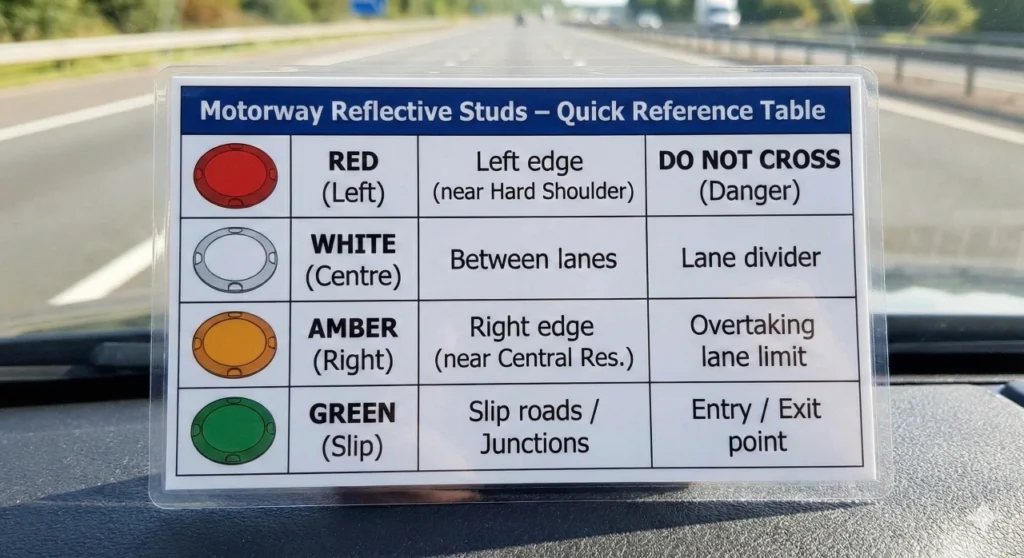
Motorway Reflective Studs – Quick Reference Table
Need a cheat sheet for revision? Use this table to memorise the positions.
| Stud Colour | Position on Road | Meaning |
| White | Between lanes | Separates traffic lanes (mid-road) |
| Red | Left edge | Marks the Hard Shoulder / road edge |
| Amber | Right edge | Marks the Central Reservation |
| Green | Slip roads & lay-bys | Marks entry and exit points |
Common Mistakes Learners Make
Even experienced drivers can get confused. Here are the top pitfalls to avoid:
- Confusing Amber and Green: It is easy to mix these up in the theory test. Remember: Amber is for the central barrier; Green is for going off (exits).
- Thinking Red Studs are on the Right: Since we drive on the left in the UK, the “danger” line (hard shoulder) is on our left. Red studs are always on the left edge.
- Ignoring Stud Colours in Fog: Some drivers focus only on the car in front. In fog, trust the studs to keep your lane position, not the tail lights ahead which might be drifting.
How Motorway Reflective Studs Appear in the Theory Test
The DVSA (Driver and Vehicle Standards Agency) tests this knowledge in several ways:
- Multiple-Choice Questions: “What colour are the reflective studs between the hard shoulder and the left-hand lane?”
- Image-Based Questions: You may be shown a CGI image of a motorway at night and asked to identify the road layout based on stud colours.
- Hazard Perception: While less common in the video clips, spotting a junction (green studs) early helps you anticipate merging traffic.
Tips to Remember Cat’s Eyes Colours Easily
Struggling to remember which is which? Try this simple mnemonic to visualise the motorway from left to right:
“Red on the Left, Amber on the Right, White in the Middle, Green for the Exit.”
- Visual Trick: Imagine a traffic light turned sideways. Red stops you going left (off road), Amber warns you on the right (barrier), and Green lets you go (slip road).
Try Our Free Motorway Reflective Studs Quiz
Think you have mastered the Highway Code on road studs? Don’t just read about it—test yourself!
Results


#1. What colour reflective studs are found between the lanes on a motorway?
White studs mark the lane dividers between lanes travelling in the same direction.
#2. You are driving in the left-hand lane of a motorway. What colour studs mark the edge of the road to your left?
Red studs mark the left edge of the carriageway, separating the driving lane from the hard shoulder.
#3. Where would you find amber reflective studs on a motorway?
Amber studs are positioned on the right-hand edge of the carriageway, next to the central reservation.
#4. What do green reflective studs indicate on a motorway?
Green studs mark the boundary at slip roads, lay-bys, and junctions where traffic joins or leaves.
#5. You see red reflective studs ahead. Which part of the road do they mark?
Red studs are always on the left, marking the boundary of the hard shoulder or verge.
#6. In heavy fog, which road studs help you maintain your lane position in the middle of the motorway?
White studs separate the lanes you are driving in, helping you stay in lane when visibility is poor.
#7. If you see amber studs to your right and white studs to your left, which lane are you likely in?
Amber studs mark the central reservation (right edge). If you are next to them, you are in the right-most overtaking lane.
#8. Which statement is true about green reflective studs?
Green studs specifically mark the layout changes where slip roads merge with or diverge from the main carriageway.
#9. Why are reflective studs particularly important during night driving?
Their primary function is retro-reflection, bouncing headlamp light back to the driver to outline the road ahead.
#10. What is the correct order of stud colours across a standard 3-lane motorway from Left to Right?
From left to right: Red (hard shoulder), White (lane 1-2 divider), White (lane 2-3 divider), Amber (central reservation).
#11. You are entering a motorway from a slip road. What colour studs will you cross to join the main carriageway?
Green studs mark the boundary between the slip road and the main motorway lanes.
#12. If you mistakenly cross the red studs on your left, where have you likely entered?
Crossing the red studs to your left means you have moved out of the driving lane and onto the hard shoulder.
#13. Which studs would you see on the right-hand edge of a dual carriageway?
Just like on a motorway, the right-hand edge next to the central barrier on a dual carriageway uses amber studs.
#14. What shape of light beam do Cat’s Eyes generally reflect?
Cat’s Eyes reflect a steady beam of light back to the source (your vehicle). They do not flash or rotate.
#15. Who is credited with inventing the reflective road stud (‘Cat’s Eye’)?
Percy Shaw of Halifax, UK, invented the Cat’s Eye in 1933.
Taking a mock quiz is one of the most effective ways to make sure this information stays fresh before your test date. For more motorway sign quizzes, explore our complete guide to motorway signs and their meanings.
FAQs – Motorway Reflective Studs
What colour reflective studs mark the hard shoulder?
Red studs. They mark the left-hand edge of the carriageway, separating the driving lanes from the hard shoulder.
Are cat’s eyes signs only used on motorways?
No. While they are most famous for motorway usage, reflective studs are also used on A-roads, dual carriageways, and unlit country roads to mark the centre lines and hazardous edges.
Do reflective stud colours differ outside the UK?
Yes, they can. While many European countries follow similar conventions, systems differ globally. For example, in the US, yellow often marks the centre line. Always check the local road laws if driving abroad.
Conclusion
Whether you are revising for your theory test or just want to feel more confident driving at night, understanding motorway reflective studs is essential. These small but mighty markers guide you through the darkest nights and the foggiest mornings.
Remember the golden rule: Red on the left, Amber on the right. Keep that in mind, and you will navigate the UK motorway network safely and correctly.