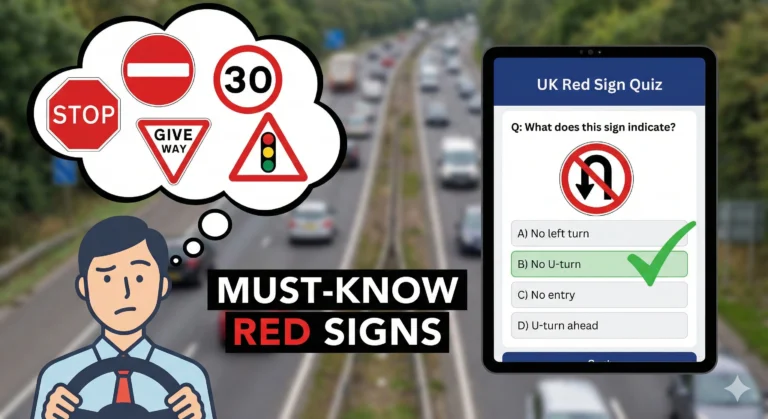
When you are behind the wheel, red usually means one thing: pay attention immediately. But do you know the difference between a red circle and a red triangle? Getting these mixed up isn’t just dangerous—it’s the quickest way to fail your theory test.
In this guide, we break down the 20 most critical red road signs in the UK, from mandatory instructions to urgent warnings. Once you’ve studied up, scroll to the bottom to take our “Pass the Road” Quiz and see if you can score 100%.
Results


#1. You see this warning sign with a falling rocks symbol. What is the primary hazard?
This sign specifically warns of the risk of falling or fallen rocks. Be prepared to stop or steer around debris.

#2. As a general rule, what instruction does a road sign in a Red Ring or Circle convey?
Red rings or circles are prohibitory signs. They tell you what you must not do (e.g., do not exceed 30mph, no overtaking).
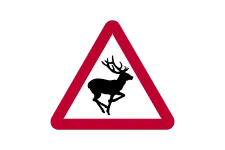
#3. You encounter this sign on a country road. What should you look out for?
This sign warns specifically of Wild Animals. It is distinct from the “Cattle” sign used for farm livestock.
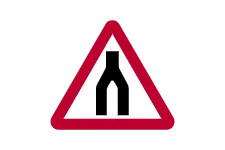
#4. You see this sign while driving on a divided road. What does it signify?
This sign indicates the End of dual carriageway. The road will return to a single carriageway with two-way traffic.
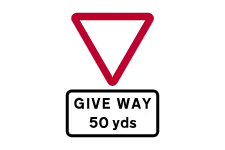
#5. What does this inverted triangle sign with “50 yds” indicate?
This plate indicates the distance to the GIVE WAY line. Drivers should prepare to slow down or stop in 50 yards.
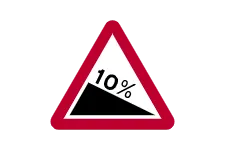
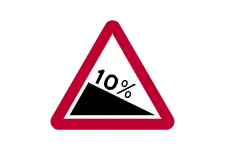
#6. You are driving and see this triangular sign with “10%”. What does it mean?
This sign warns of a Steep hill downwards. The percentage (10%) indicates the gradient (equivalent to 1:10).
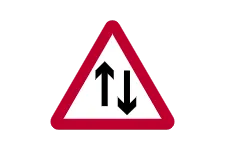
#7. What does this sign with two opposing arrows indicate?
This sign warns of Two-way traffic. It is often found at the end of a one-way street or where a dual carriageway ends.
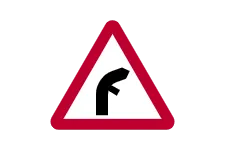
#8. You see this sign on a winding road. What hazard is approaching?
This sign warns of a Junction on a bend. The symbol shows the shape of the junction hidden by the curve.
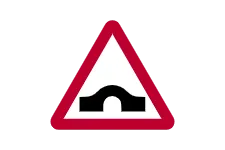
#9. What hazard does this sign with a curved bridge symbol indicate?
This sign indicates a Hump bridge. These bridges can be steep and may limit visibility or cause vehicles to “jump” if taken too fast.
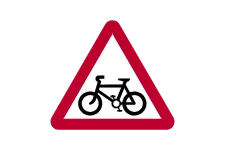
#10. You see a red triangle with a bicycle symbol. What does this warn you of?
This is a warning sign for a Cycle route or cyclists ahead. Drivers should be extra vigilant for bikes entering or crossing the road.
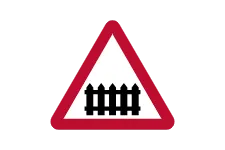
#11. You see this sign on the road ahead. What does it indicate?
This triangular warning sign specifically depicts a fence-like symbol, which indicates a level crossing with a gate or barrier. Drivers should be prepared to stop if the barriers begin to lower. Note: A level crossing without a barrier uses a symbol of a steam train instead.
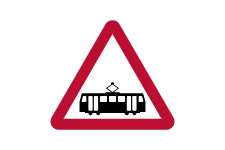
#12. You are driving in a city centre and see this warning sign. How should you proceed?
This sign warns drivers of trams crossing the road ahead. In the UK, trams often run on tracks integrated into the road surface. You should look out for overhead cables and be mindful that tram tracks can be slippery, especially for cyclists and motorcyclists.
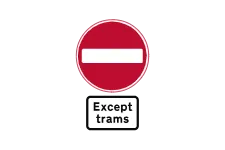
#13. You encounter this sign at the entrance to a street. Which statement is correct?
The red circle with the white horizontal bar is the standard “No Entry” sign for all vehicular traffic. However, the white sub-plate underneath clearly states “Except trams”. This means that while the route is forbidden for cars, vans, and buses, trams are permitted to use it—often because the road is physically narrow or contains tracks unsuitable for standard tyres.
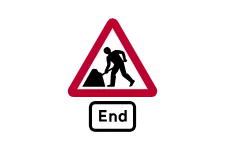
#14. You are driving through a construction zone with a temporary speed limit of 30 mph. You then see this road works sign with an “End” plate beneath it. What does this indicate?
The “man digging” symbol inside a red triangle is a warning for road works. When it is supplemented by a white “End” plate, it indicates the end of the road works and that any temporary speed limit applied specifically to those works has finished. It may be followed by a sign showing the permanent speed limit for the road ahead.
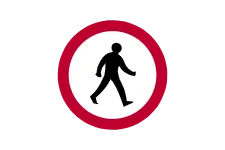
#15. You are approaching a tunnel and see this sign at the entrance. What is the mandatory instruction?
In the UK, a red circle indicates a prohibitory instruction—it tells you what you must not do. This specific sign means no pedestrians are allowed beyond that point. You will often see this at the start of motorways, slip roads, or certain tunnels where it is unsafe for people to walk.
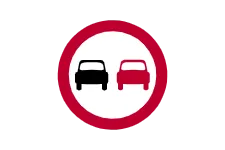
#16. You are driving on a narrow country road and see this sign. What is the rule you must follow?
This sign, featuring two cars side-by-side inside a red circle, indicates “No overtaking”. In the UK, red circles are used to give mandatory negative instructions—meaning they tell you what you must not do. You must remain behind the vehicle in front until you pass a sign that cancels this restriction.
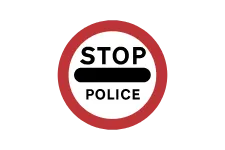
#17. You are driving along a road and see this sign being displayed by a police officer. What action are you required to take?
This sign is a mandatory instruction. Vehicles must not go beyond the sign where it is displayed by a police officer or a traffic warden. Failing to stop when directed by an officer in this manner is a serious legal offence.
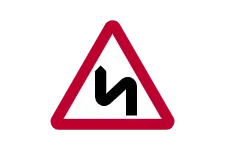
#18. What hazard does this sign with a winding arrow warn you of?
This sign warns of a Double bend ahead, with the first bend being to the left. (If the symbol were reversed, the first bend would be to the right).
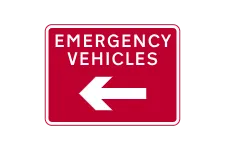
#19. You see this red sign with a white arrow. What is its purpose?
Signs with a red background and white text like this specifically indicate a route for emergency vehicles to a temporary incident control point.
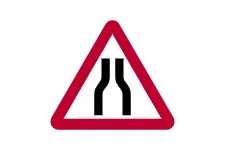
#20. You are driving and see this triangular sign. How does the road layout change?
This sign warns that the road narrows on both sides ahead. Drivers should be prepared to adjust their road position and speed.
The Golden Rule: Shapes Matter
Before we look at specific signs, you need to know the “Shape Code.” Red signs fall into two main categories:
- Red Circles (Orders): These are prohibitory. They tell you what you MUST NOT do (e.g., No Overtaking).
- Red Triangles (Warnings): These alert you to hazards ahead. They are asking you to be aware and slow down (e.g., Hump Bridge).
Art 1: Mandatory Red Circles (The “Must Nots”)
These signs are not suggestions. Disobeying them is a traffic offence.
1. No Entry (Except Trams)
We often see the standard “No Entry” circle, but city centres often have the tricky variant: No Entry… Except Trams.
- What it means: The road is closed to regular cars and vans, often because of tram tracks or narrow lanes.
- Common Mistake: Drivers ignore the “Except Trams” plate and assume it’s a total road closure, or worse, they enter thinking the sign doesn’t apply to them.
2. No Overtaking
- Visual: Two cars (one red, one black) side-by-side.
- The Rule: You must stay behind the vehicle in front. This is common on narrow country roads or areas with poor visibility.
3. No Pedestrians
- Visual: A walking figure inside a red circle with a line through it (or just the circle).
- Where you see it: Tunnel entrances, flyovers, and motorways where walking is deadly.
4. Stop (Police)
- Visual: “STOP POLICE” text.
- The Rule: You must not drive past this sign when it is held up by a police officer or traffic warden.
(Other common circles include: Maximum Speed Limits, No U-Turns, No Left/Right Turn, Height Restrictions).
Part 2: Warning Red Triangles (Hazards Ahead)
These signs give you time to react before you hit the hazard.
5. Falling Rocks
- Visual: Rocks tumbling down a slope.
- The Hazard: Found in hilly areas (like the Peak District). Be ready to brake for debris on the road.
6. Hump Bridge
- Visual: A bridge symbol with a distinct hump.
- The Hazard: If you hit these fast, your car will leave the ground. You usually can’t see oncoming traffic on the other side, so slow down.
7. Trams Crossing
- Visual: A tram car icon.
- The Hazard: Trams move quietly and cannot steer to avoid you. Their tracks can also be slippery for cyclists.
8. Wild Animals
- Visual: A silhouette of a deer (or similar animal).
- The Hazard: Unlike the “Cattle” sign (which implies a farm nearby), this warns of unpredictable wild animals leaping into the road.
9. Dual Carriageway Ends
- Visual: Two roads merging into one.
- The Hazard: You are returning to two-way traffic. Do not try to overtake as if you are still on a dual lane.
10. Steep Hill Downwards (10%)
- Visual: A percentage number on a slope.
- The Action: Check your brakes and switch to a lower gear to maintain control.
Part 3: The “Tricky” Informational Signs
Sometimes, a red sign is purely for information or specific routing.
11. Emergency Vehicles Route
- Visual: “Emergency Vehicles” text on a red rectangular background.
- Meaning: This marks a route specifically for ambulances and fire engines to reach an incident point. It’s not a parking spot!
12. End of Road Works
- Visual: The “man digging” sign with an “End” plate.
- Meaning: The road works are finished, and any temporary speed limits (like 30mph) are no longer in force.
Conclusion
Knowing your road signs isn’t just about passing a test; it’s about keeping yourself and others safe. Whether it’s spotting a “No Overtaking” zone or identifying a “Trams Only” route, these red signs are the most critical signals on the UK network.
Did you find this quiz helpful? Share it with a friend who is learning to drive!