
Is 2026 the year you finally ditch the bus pass and get behind the wheel? Or perhaps you’re looking to upgrade your career with a Class 1 HGV license?
The road to freedom in the UK has changed. It’s no longer just about “mirror, signal, maneuver.” In the post-pandemic landscape, it’s about navigating 22-week waiting lists, battling booking bots, and understanding a license alphabet that runs from AM to D1+E.
Whether you are a 17-year-old learner or a career switcher, this guide covers every UK Driving License Categories, the process, the costs, and the waiting times you need to know about right now.
1. The Starting Line: Your Provisional License
Before you can even think about parallel parking, you need the green card. You can apply for your provisional driving license as early as 15 years and 9 months old, though you can’t ride a moped until 16 or drive a car until 17 (unless you receive the enhanced rate of PIP mobility component).
- Cost: £34 online (cheaper than the £43 postal route).
- Requirement: You must have lived in the UK for at least 185 days in the past 12 months.
Apply for your provisional driving license on GOV.UK
2. Decoding the Alphabet: UK Driving License Categories Explained
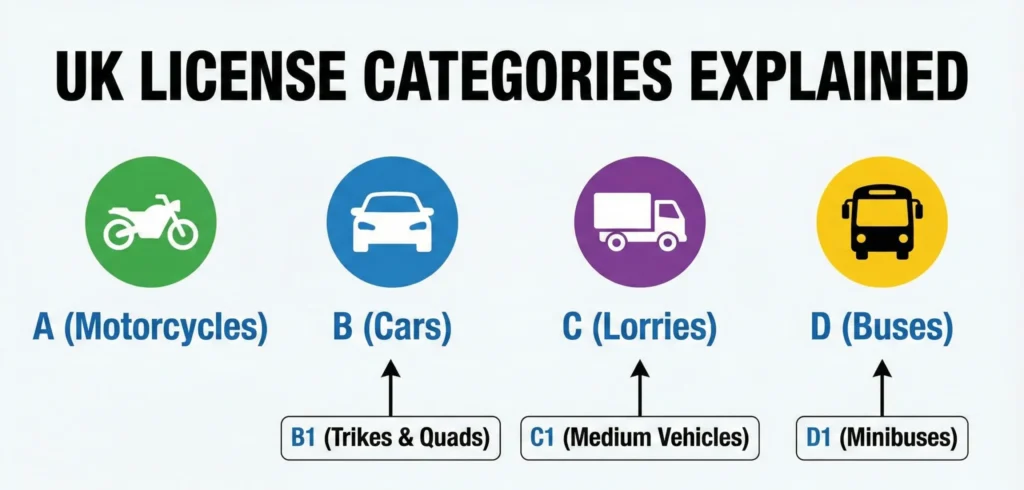
The UK system is tiered to stop new drivers from jumping onto high-power machines too early. Here is the breakdown of what you can drive and when.
Two Wheels: The Motorcycle Ladder
The motorcycle route is strictly progressive. You can’t just buy a superbike and hope for the best.
| Category | Vehicle | Min Age | Requirements |
| AM (Moped) | 50cc, max 28mph | 16 | CBT + Theory + Practical |
| A1 (Light Bike) | 125cc, max 11kW | 17 | CBT + Theory + Practical |
| A2 (Medium Bike) | Max 35kW (approx 47bhp) | 19 | Theory + Practical (or progressive access from A1) |
| A (Unrestricted) | Any motorbike | 24 (or 21*) | Direct Access (DAS) or 2 years holding A2 |
Four Wheels: The Car Categories
Most of us start here. But did you know the towing rules changed recently?
Category B (Manual Car):
The gold standard. Allows you to drive manual or automatic cars up to 3,500kg MAM (Maximum Authorised Mass).
Category B Auto:
Restricts you to automatic cars only. With the rise of EVs, this is becoming more popular, but passing in a manual gives you more flexibility.
Category B+E (Towing):
Good News! As of late 2021, you no longer need a separate test to tow a trailer up to 3,500kg. The DVLA automatically adds this entitlement to your record.
The Heavy Hitters: HGV & PCV
If you want to drive professionally, the stakes (and the vehicles) get bigger.
- Category C1: Medium trucks (3.5t – 7.5t), like ambulances or large removal vans.
- Category C (Class 2): Rigid lorries over 3.5t.
- Category C+E (Class 1): Articulated lorries (The Big Rigs) up to 44 tonnes.
- Category D: Buses and coaches with more than 8 passenger seats.
Pro Tip: To drive these professionally, you must pass the Driver CPC (Certificate of Professional Competence), which involves 4 modules, including a theory test, case studies, and a practical demonstration.
3. The 2026 Reality: Waiting Times & The “Backlog”
Let’s be real—booking a test in 2026 is tough. The national average waiting time for a car practical test is currently hovering around 22 weeks.
- Why the delay? A massive post-COVID backlog and a shortage of examiners.
- Hotspots: If you are in London, Birmingham, or Manchester, waits often hit the 24-week cap.
- Rural Hack: Centers in places like Ballater (Scotland) or Llandrindod Wells (Wales) have shorter lists and higher pass rates (sometimes 70%+), compared to city centers like Erith or Birmingham which sit around 30-35%.
Our Advice: Book your theory test immediately. Once passed, book any practical slot you can find, even if it’s 6 months away. You can then look for cancellations.
Check official driving test waiting times on GOV.UK
4. Show Me the Money: Costs Breakdown (2026)
Driving isn’t cheap, but it’s an investment for life. Here is what you will pay in official DVSA fees (excluding lesson prices):
- Provisional License: £34
- Car Theory Test: £23
- Car Practical Test: £62 (weekday) / £75 (weekend)
- HGV/PCV Theory (Part 1a & 1b): £37 total
- HGV/PCV Practical (Part 3b): £115 (weekday)
- HGV Medical (D4 Form): £50–£100 (Don’t pay your GP £150+! Use a private specialist).
5. The Fun Section: Weird Signs & Epic Fails
To lighten the mood, remember that even if you fail, you probably won’t fail as badly as these Reddit legends:
- The “Instant” Fail: One candidate failed within seconds by turning left out of the test center… directly into oncoming traffic on a one-way street.
- The “Polite” Fail: Failing for waving a pedestrian across the road. (Rule: Don’t wave! It’s unpredictable and dangerous).
- Migratory Toads: Yes, there is an official UK road sign for “Migratory Toads Crossing.” You’ll find it in rural areas during breeding season. If you see a toad silhouette in a red triangle, slow down!
- Tank Crossing: Around Salisbury Plain, you might see a sign with a tank on it. In a battle between your Ford Fiesta and a Challenger 3 Tank, the tank wins. Yield.
Test Your Sign Knowledge: Visit the Quizzes Page
Braking Distance Calculator
Understanding UK driving licence categories is only part of becoming a safe and confident driver. No matter which category you apply for, knowing how quickly your vehicle can stop is essential for passing the theory test and real-world driving.
That’s why it’s important to understand braking distance, which depends on speed, road conditions, and reaction time. You can easily test different scenarios using our braking distance calculator to see how stopping distances change and improve your hazard awareness.
Conclusion
Getting a UK driving licence in 2026 takes planning, patience, and the right preparation. Understanding the different UK driving licence categories is essential, whether you’re searching for a local driving instructor or planning to fast-track your HGV or professional driving career.
Even if waiting times feel long, using that time to prepare for your theory test, learn road rules, and practise safely will give you a strong advantage.
Apply for your provisional licence early, stay consistent with your learning, and move through each stage with confidence. With the right approach, you’ll be on the road to independence and long-term success.